Continuing last month’s exploration of high sites across the country, both well known and less well known, that reflect the profound impact…

Continuing last month’s exploration of high sites across the country, both well known and less well known, that reflect the profound impact…

Just off St David’s Head in Pembrokeshire, Wales, lies Ramsey Island. It is currently owned and managed by the Royal Society for…

The decision to build a new visitors’ centre at St Albans Cathedral in Hertfordshire – part of the Heritage Lottery-funded project, Alban,…

New research analysing palaeoclimate data in conjunction with archaeological findings has provided evidence for how resilient the community of Star Carr –…

A detailed LiDAR survey of the Antonine Wall – the Roman military structure that ran east–west between the Firth of Forth and…

There has been a longstanding debate among archaeologists over the purpose of Bronze Age (c.2500-800 BC) hoards, particularly those including objects that…

In this month’s ‘Science Notes’, we are discussing yet another form of dating: uranium-thorium (U-Th) dating, also known as uranium-series dating. Readers…

Dublin is known for the exceptional anaerobic conditions that have preserved swathes of medieval archaeology there (see CA 328), and a recent…

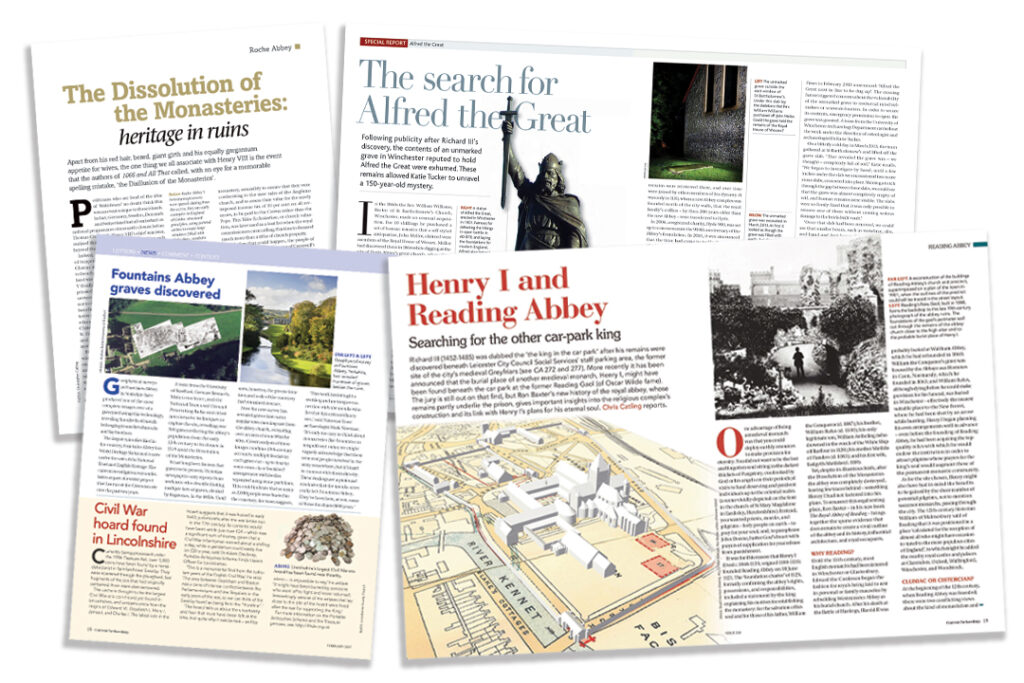
In the 16th and 17th centuries, the Reformation and the Civil War reduced a great many of Britain’s abbeys and castles to…

Perched on a peninsula in the heart of the Orkney archipelago, the Ness of Brodgar is a truly remarkable site. Long-running excavations…

With a mixture of personal and archaeological anecdotes, this short book gives a real insight into the life and studies of Brenda…