Uncovering 8,000 years of life and death on the Cotswold Edge
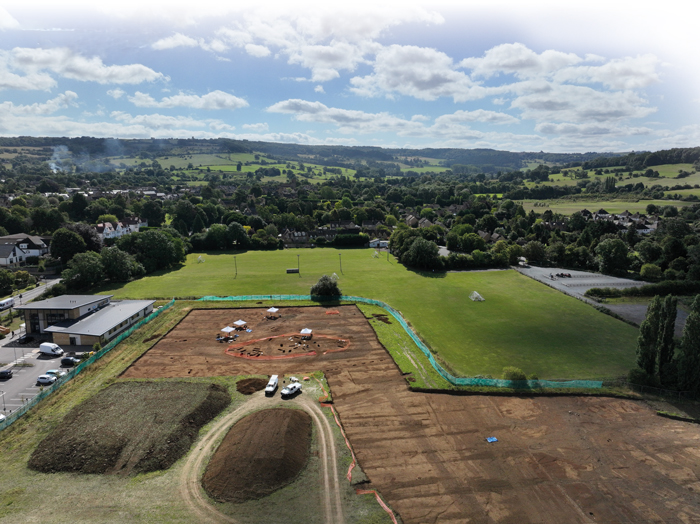
Recent excavations at Milestone Ground on the eastern edge of Broadway have revealed one of the most intriguing archaeological landscapes yet found in Worcestershire. Beneath quiet pasture lay evidence of human activity stretching back 8,000 years, including Mesolithic flint tools, Bronze Age burials, hundreds of Iron Age storage pits, a Roman farmstead, and the largest late Roman cemetery known in the county. Constance Mitchell reports.
Standing at the foot of the village of Broadway has long been celebrated as one of England’s most picturesque settlements. Often described as the ‘Jewel of the Cotswolds’, its High Street is lined with honey-coloured limestone buildings, historic coaching inns, and galleries that attract visitors from across the world. Few of these visitors would imagine, though, that beneath the quiet fields on the village’s eastern edge lies one of the most complex archaeological landscapes yet discovered in Worcestershire.
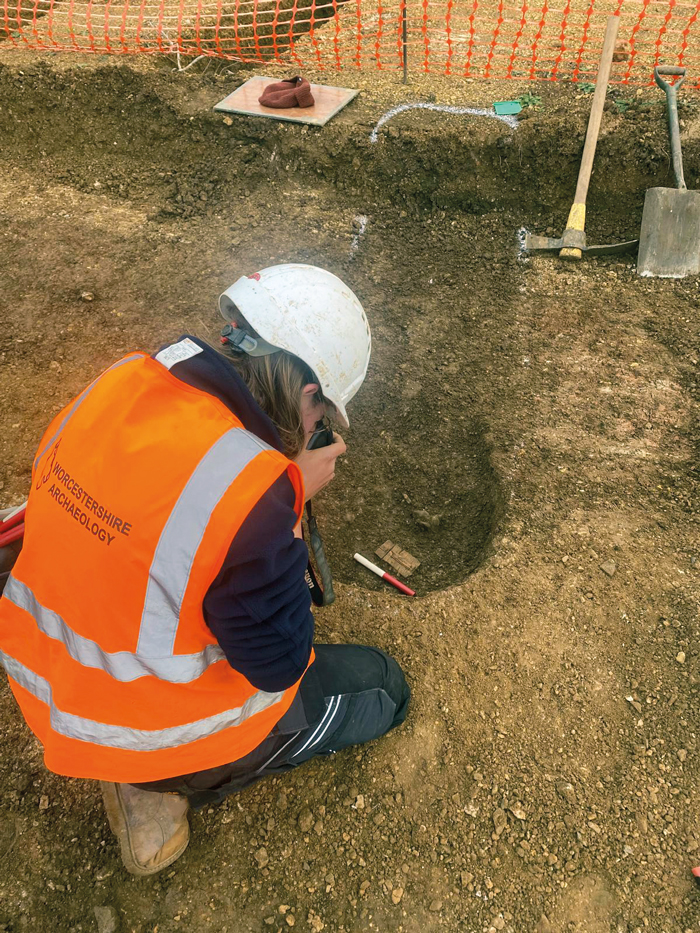
Between the summers of 2024 and 2025, Worcestershire Archaeology’s excavations at Milestone Ground revealed a remarkable sequence of human activity stretching back c.8,000 years. From the earliest hunter-gatherers who moved through the landscape after the end of the last Ice Age, to Roman farmers and Saxon craftspeople, generations returned to this place again and again. The discoveries have transformed our understanding of Broadway’s past, revealing a landscape shaped by human lives for millennia. The story of this discovery, however, did not begin with the modern excavation. Instead, its rediscovery began almost a century earlier.
REDISCOVERING THE LANDSCAPE
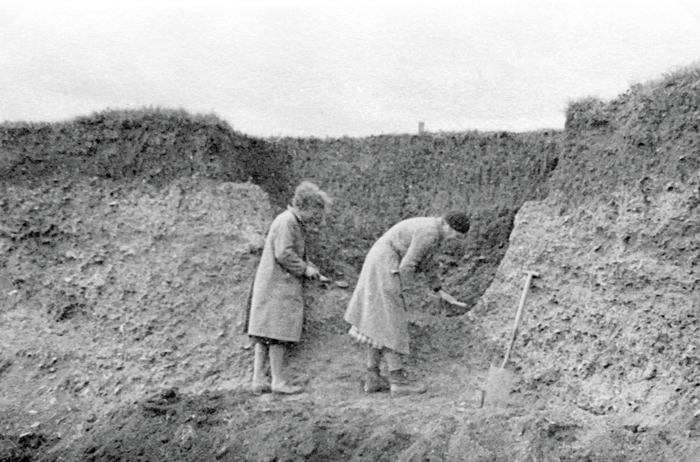
In the 1930s, gravel extraction began in the fields between Childswickham Road and Station Road – and, as quarrying progressed, workers began to uncover unexpected remains. Human skeletons appeared in the gravel, along with fragments of pottery and other artefacts, while the discovery of large ditches cut into the natural geology hinted at ancient occupation of the landscape. News of these finds soon reached local archaeologists, who realised that important evidence was being uncovered – and potentially destroyed – by the ongoing extraction. Among those who responded was Catherine Nancy Smith (1901-1953; she was usually known by her middle name). At a time when archaeology was still largely dominated by men and women were often discouraged from its more ‘hands-on’ aspects, Smith took an active role in investigating the exposed remains, leading excavations and working on a voluntary basis to carefully uncover and record graves and associated features before they were lost to further quarrying. Her observations confirmed that the site was home to a Roman cemetery, as well as showing evidence of nearby settlement activity, and these discoveries were published in 1946 through the Worcestershire Archaeological Society, ensuring that this aspect of Broadway’s history was preserved for posterity.
For decades after this, the fields of Milestone Ground appeared quiet and unremarkable. Yet hints of the buried archaeology continued to emerge. Aerial photography revealed faint patterns appearing across the fields during dry summers: cropmarks tracing the outlines of ditches and pits. These extended over an area of some 2.3ha (5.7 acres), far beyond the outline of the old quarry, showing that the remains uncovered during the 1930s represented only part of a much larger archaeological landscape.
Further clues emerged in 2005, when members of the Worcestershire Young Archaeologists’ Club carried out fieldwalking in the area. Their finds included Mesolithic flints, indicating that human activity on the site stretched back thousands of years before the Roman occupation that hadalready been documented. Surveys in 2014 provided evidence of both Iron Age and Roman activity – and a couple of years ago archaeologists were provided with the opportunity to explore this underlying landscape in greater detail, when development proposals were put forward for the site.
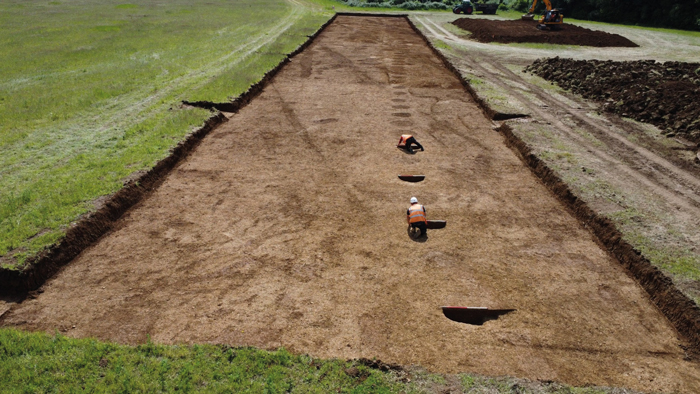
Wychavon District Council commissioned Worcestershire Archaeology (part of Worcestershire County Council) to carry out a large-scale excavation ahead of construction – and, as soon as the topsoil had been stripped away, the team was immediately struck by the density of archaeology that was preserved just 30-50cm (12-20in) under the surface. New features appeared daily as our investigations continued, and it quickly became clear that, rather than reflecting the remains of a single settlement, Milestone Ground was a place that had been repeatedly visited and reused over many millennia.


Examples of Neolithic pottery from the site. On the left is a piece of Grooved Ware with ‘pie-crust’ decoration, while right is a fragment of Impressed Ware bearing markings made using a bird bone. IMAGE: Worcestershire Archaeology
HUNTER-GATHERERS AND FIRST FARMERS
The earliest evidence for a human presence at Milestone Ground dates back around 8,000 years to the later Mesolithic period, when Britain was blanketed by dense woodland and its inhabitants lived as nomadic hunter-gatherers moving seasonally across the landscape. Groups like these clearly visited Broadway, too, as our team found worked flints scattered across the site, in both contemporary and later deposits. They include a variety of tools that were probably used for tasks such as cutting meat, preparing hides, and working wood, as well as waste flakes produced during their manufacture or repair. Together, these objects offer a fascinating glimpse into the everyday life of the Mesolithic communities that passed through, and worked in, this transitional landscape on the edge of the Cotswold escarpment.
The flints add to a growing body of evidence which suggests that this area was significant for later Mesolithic populations. Just a short walk from Milestone Ground, on the south side of the Badsey Brook, an excavation undertaken ahead of flood alleviation works (known as the FAS site) also produced a substantial assemblage of nearly 4,000 Mesolithic flints. There, though, analysis revealed an emphasis on hunting implements rather than processing tools like scrapers, while palaeoenvironmental evidence confirmed the presence of aurochs, deer, and wild pig. It will be fascinating to compare the flints from Milestone Ground to these previous finds as post-excavation analysis progresses.
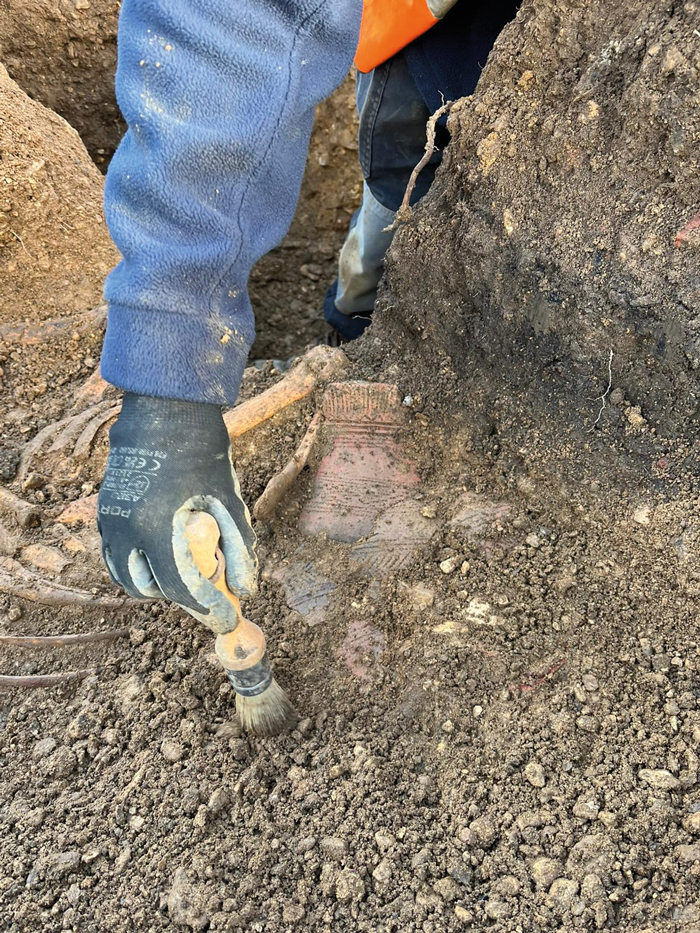
In the Neolithic period, the arrival of farming c.4000 BC transformed not only the lives of those who lived in Britain at the time, but the landscapes that they called home. Communities began clearing woodland, cultivating crops, and raising livestock, as well as making use of emerging technologies like pottery and polished stone tools. At Milestone Ground, we found more than 30 Neolithic pits across the site, often arranged in pairs and backfilled with a substantial quantity of pottery, animal bone, and other artefacts including flint, worked-bone tools, and fragments of polished axe.
Interestingly, this did not mark the site’s first encounter with Neolithic pottery. Sherds of Grooved Ware were recovered during the excavations of the 1930s, and when Professor Stuart Piggott identified this distinctive style of flat‑based, decorated pottery as a recognisable group in 1936, the Broadway pieces featured in his early study. These fragments, combined with the large quantities from our more recent excavations, represent one of the county’s biggest assemblages of Grooved Ware yet found. This collection stands out, too, for its distinctive decoration, featuring a wavy line ‘pie-crust’ pattern that is also seen on examples from Anglesey, but is otherwise unknown in Worcestershire.
We have recovered pieces of Impressed Ware as well, which typically pre-dates Grooved Ware. Some of these sherds had been decorated with marks created using a bird bone, a small detail that reveals something of the creativity and craftsmanship of the people who produced this pottery. From such finds, we now know that early farming communities were active in the Broadway area nearly 6,000 years ago; we hope that forthcoming environmental work will reveal more about how the landscape was being used during this period.
This is an extract of an article that appeared in CA 435. Read on in the magazine, or click here to read it online at The Past, where you can read all of the Current Archaeology articles in full as well as the content of our other magazines, Current World Archaeology, Ancient Egypt, and Military History Matters.