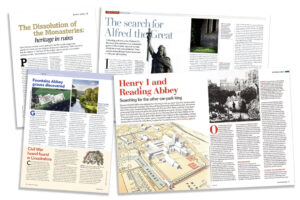
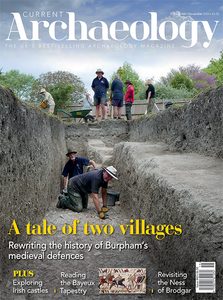
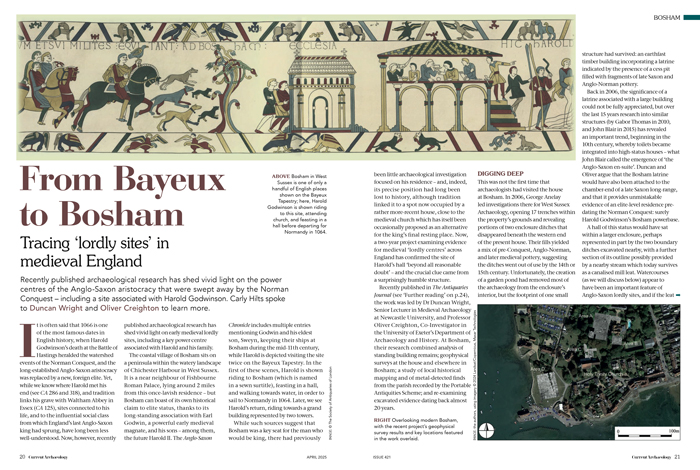
The news that the Bayeux Tapestry will be making a once-in-a-lifetime visit to Britain from September 2026 until July 2027 made me think about sites associated with the Norman Conquest that might be of interest to the readers of Current Archaeology. By way of introduction, I will share some context-setting articles on the Bayeux Tapestry itself, which has featured regularly in the magazine, commencing in CA 5 (November 1967). This initial appearance came in a piece on the origins of the castle in Britain; subsequent mentions are found in CA 224 (November 2008), on the archaeology of the Domesday Book; in CA 320 (November 2016), on the life of William the Conqueror; in CA 407 (February 2024), on the evidence for the animals depicted in the Tapestry; in CA 421 (April 2025), on ‘lordly’ sites of the Conquest in the archaeological record; and, most recently, in CA 422 (May 2025), on medieval war horses.
OLD BATTLES AND NEW BEGINNINGS
The site of the Battle of Hastings, and the abbey founded there, is the obvious place to commence this column. CA 60 first visited in February 1978 – alongside an unexpected diversion 70 miles (110km) north of the battlefield to Waltham Abbey in Essex, on the border of modern-day Greater London. A place of worship since the 7th century AD, Waltham Abbey was rebuilt and refounded by Harold Godwinson in 1060. It is also believed (though not proven) to be the king’s final resting place after his death at Hastings in 1066, a topic that CA 125 (July 1991) and CA 421 (April 2025) pick up on. So here is a ‘counter-pilgrimage’ site to visit amid the Norman lovefest that we will surely see in the later part of 2026. Current Archaeology has returned to Hastings three more times since the 1970s: in CA 224 (November 2008), in the above-mentioned project mapping the archaeology of the Domesday Book; in CA 286 (January 2014), when Time Team examined the official battlefield site alongside rival claimants; and in CA 421 (April 2025), which explored evidence for the Anglo-Saxon aristocratic sites of power that were swept away in the post-Conquest years.
Another ‘great site’ that I will mention in this section has an ambiguous position amid all the jockeying for power: Westminster Abbey. With pre-Conquest origins, this was a treasured place in Anglo-Saxon aristocratic high society, thanks to the patronage of Edward the Confessor, but it was also the place where William chose to have himself crowned king on Christmas Day 1066. It is hypothesised that Harold had been crowned there earlier that year, although there is no surviving evidence to prove this. Current Archaeology has visited this location repeatedly down the years, so much so that I will devote a future column to it.
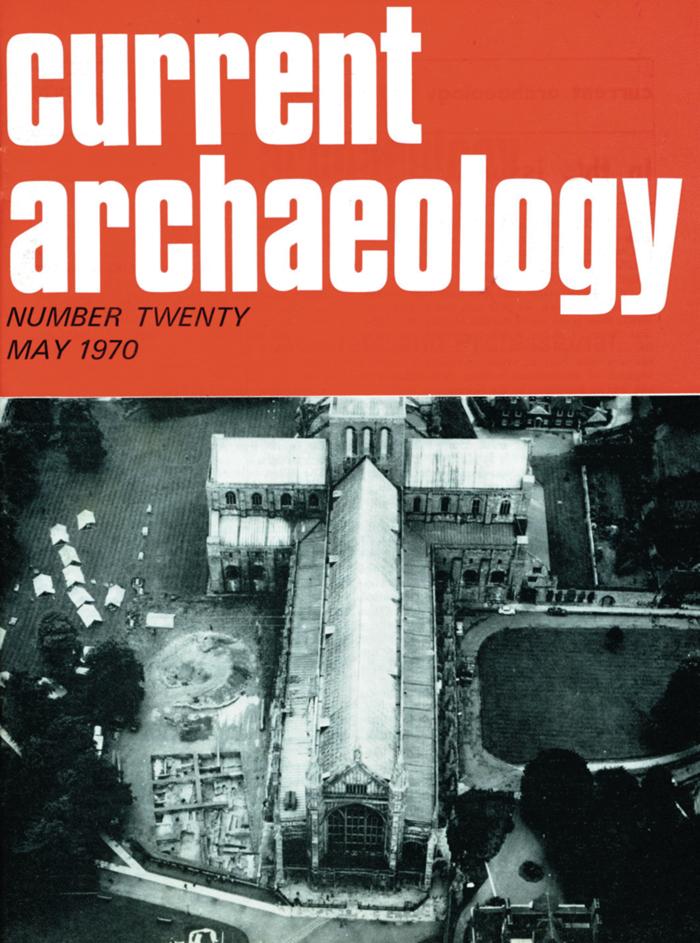
My final stop in the first half of this month’s column is Winchester, another site whose identity shifted during this era. The city, and especially its sequence of religious and royal sites, has a long history and strong associations with Anglo-Saxon elites. As far as we can be certain in this period of fluid communities and fragmentary records, the city was, if not the ‘capital’ of the West Saxons at a time when the court was peripatetic, then one of two of Alfred the Great’s ‘proto-capitals’ in the pre-Conquest period (along with London), each also being a key minting site for Wessex. For these reasons, the Normans quickly consolidated control there through military, administrative, and ecclesiastical means, building the castle from c.1067 onwards and the cathedral from 1079. These sites have been explored numerous times by Current Archaeology, beginning in CA 2 (May 1967) with the first of multiple updates by Martin Biddle, who led fieldwork across the city in the 1960s-1980s. His investigations around the cathedral appear in issues including CA 6 (January 1968), CA 9 (July 1968), and CA 20 (May 1970); this work is also reviewed in CA 300 (March 2015). In the light of renewed fieldwork, CA 271 (October 2012) traced the city’s story across the breadth of the prehistoric, Roman, Anglo-Saxon, and medieval periods. The (so-far unsuccessful) search for the burial site of Alfred the Great featured in CA 288 (March 2014), while the tale of Winchester’s evolving townscape was most recently examined in CA 344 (November 2018).
PROJECTING POWER AND AUTHORITY
After William I was crowned king in December 1066, he set about consolidating his power and authority through people and places alike. Here we come to the site-based ‘big hitters’ of the post-Conquest kingdom: Dover and London, where Norman fortifications began to be built in 1066; followed by Windsor, where similar construction started in 1070, and Lincoln in 1072. These are all well-known locations whose long histories stretch far before and after William’s influence. Current Archaeology has explored each down the years, and, while Lincoln’s story may be relatively less well-known, I’m including it here for two reasons: first, it has an exceptional pedigree of direct involvement by William I, making it one of the ‘great’ sites of the early Norman kingdom; and, second, it is an important reminder that this truly was a kingdom following on from an initial conquest, not a mere incursion into primarily south-eastern England’s West Saxon territory. Norman castles quickly arose across the landscape in the following decades, but Lincoln’s was one of the first and greatest.
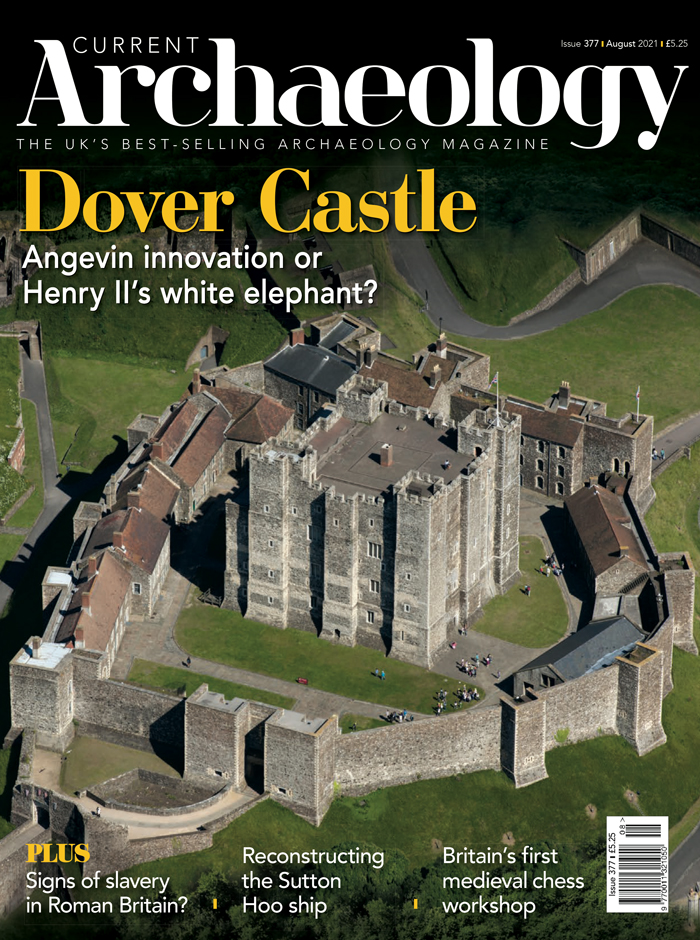
Dover I covered in part in my recent columns on the Saxon Shore (CA 433, April 2026, and CA 434, May 2026), but they focused on the prehistoric, Roman, and Anglo-Saxon harbour. While these earlier communities had occupied the highlands overlooking the shore, it was the Normans who really developed the castle site as we know it – the origins of the medieval and modern fortress whose emblematic status includes its use during a much later conflict: the Second World War. Surprisingly, it took until CA 235 (October 2009) for a systematic site visit to be made, examining the castle during the reign of Henry II (1154-1189). The magazine returned in CA 255 (June 2011) as part of a wider discussion of the origins of English castles; and, most recently, in CA 377 (August 2021), which circled back to Henry II’s innovations at the site. This is limited coverage for so important a site, and it emphasises the later medieval and modern castle, not its Norman form.
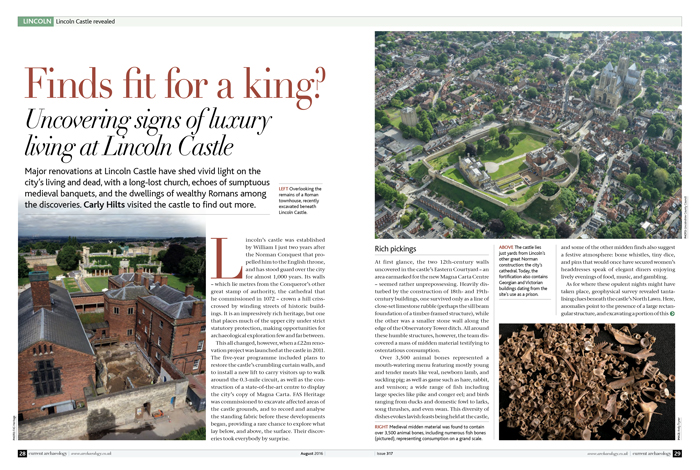
The same can be said for Windsor Castle, which has only had two proper features in CA, first in issue 255 (in the review of English castles mentioned above), and second in CA 341 (August 2018), which is the magazine’s only proper survey of this site which, for all its modern-day pomp and circumstance, has serious origins as an Anglo-Saxon, later Norman, aristocratic residence-cum-armoury that was established in an age of uncertainty. The Tower of London has fared even more poorly across the years: CA 154 (September 1997) represents the magazine’s first – and, to date, only – visit of note, which took place when the re-watering of the moat was being discussed. Given later developments, I suspect everyone is grateful that this ambitious project never came to fruition. Only Lincoln has really seen sustained interest from the magazine, first appearing in CA 129 (May 1992), which covered the cathedral. The castle site came next, in CA 280 (July 2013), which examined its Anglo-Saxon origins; and CA 317 (August 2016), which offered an in-depth, multi-period examination of the same location. The ‘Context’ spread in CA 380 (November 2021) showcased a detailed reconstruction of the castle in the late 12th century, and the most recent appearance of the fortifications came in the ‘News’ section of CA 425 (August 2025), which reported on GPR surveys highlighting their Norman development – a story that we look forward to covering in more detail soon.
All the sites mentioned are open to the public: see their websites at www.english-heritage.org.uk/visit/places/1066-battle-of-hastings-abbey-and-battlefield; www.english-heritage.org.uk/visit/places/waltham-abbey-gatehouse-and-bridge; www.westminster-abbey.org/visit-us; https://historicwinchester.co.uk/our-attractions/city-museum; www.english-heritage.org.uk/visit/places/dover-castle; www.rct.uk/visit/windsor-castle; www.hrp.org.uk/tower-of-london; and www.lincolncastle.com.