In last month’s column, I touched on two medieval Abbey in Winchester and Reading Abbey in Berkshire, the purported resting places of Alfred the Great (849-899) and Henry I (1068-1135) respectively. Here I will follow up on this theme with the story of the search for, and discovery of, the remains of Richard III (1452-1485) at Greyfriars in Leicester. This is one of the most famous archaeological projects in recent memory, one that captured international media attention, and a story that Current Archaeology was involved in reporting on from the outset.
ACT I
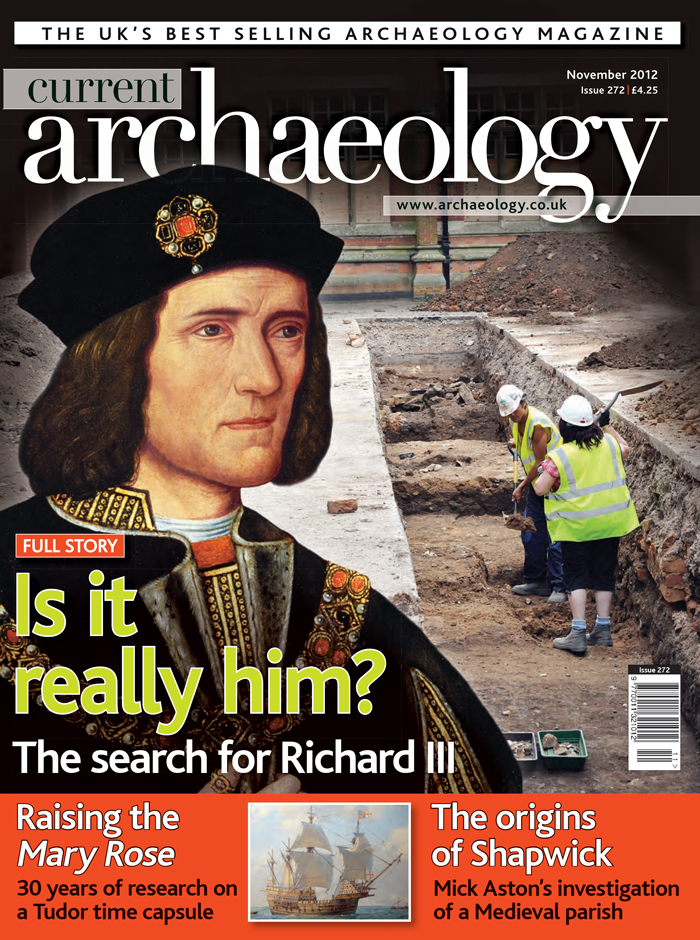
Current Archaeology first reported on Richard III in issue 272 (November 2012), when the Greyfriars project team had announced the discovery of a skeleton thought to be the lost king (based on its physical condition, evidence of battlefield injury, and location in the friary remains), but at that time his identity was not proven. For anyone interested in the comprehensive backstory of this investigation without the hyperbole of some of the mainstream media reporting, this is the place to start. The magazine’s cover feature puts both the site and the research into their full context, including Richard’s death at Bosworth some 16 miles west of Leicester; his hasty transfer and modest burial in the Franciscan Friary of Greyfriars in the city centre; that site’s subsequent loss to the Dissolution; and the search for his burial at the instigation of Philippa Langley and the Richard III Society, a group that is itself examined in CA 274’s ‘Odd Socs’ column (January 2013).
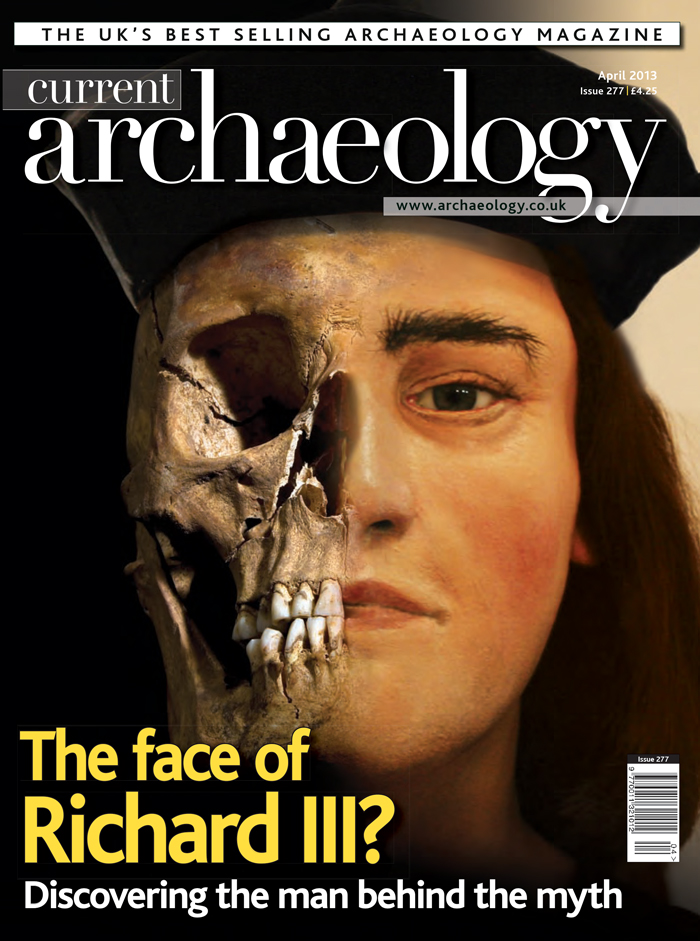
The pace of this work was brisk; the next mention of the project, and its second cover-story, came in CA 277 (April 2013), less than six months after initial reports of the likely discovery of the king’s remains. This issue covered the news that everyone was waiting for but which many – including the project’s lead archaeologist, Richard Buckley of University of Leicester Archaeological Services (see CA 425, August 2025, for more on the history of ULAS) – never imagined they would see. Previously, Buckley had stated that he would ‘eat his hat’ if they ever found the missing monarch, but DNA and osteoarchaeological analyses confirmed ‘beyond reasonable doubt’ that the burial found in the Leicester car park was that of Richard III. The reporting in CA 277 is fascinating, but not for the light-hearted, as it delves into the extensive osteoarchaeological evidence for Richard’s brutal battlefield death, as well as his experience of living with the scoliosis that might have inspired later portrayals of his twisted posture. Deservedly, the next mention of the project, in CA 278 (May 2013), came when the investigation won ‘Research Project of the Year’ in the 2013 Current Archaeology Awards. Issues across the remainder of that year then feature regular mentions not of Richard III himself, but the debate about where to rebury him, with York, Lichfield, and Leicester all in contention among the readership, until a final resting place – Leicester Cathedral – was agreed with the Ministry of Justice, as reported in CA 293 (August 2014). Further insights into the king’s remains had come in CA 289 (April 2014), with a report on genome sequencing that would allow ongoing studies of his entire genetic sequence after reburial.
INTERLUDE
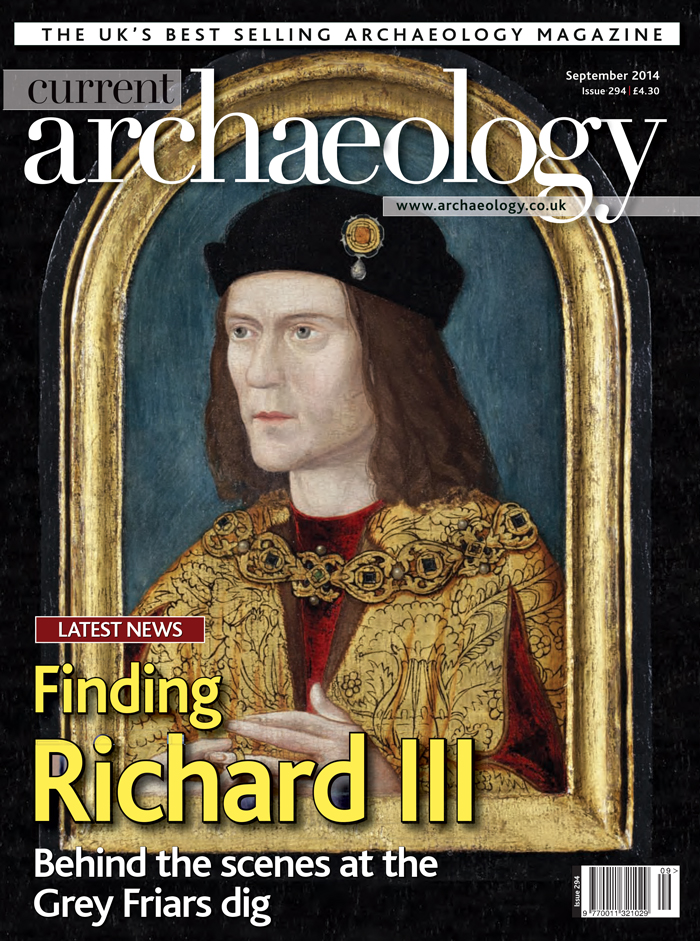
With the remains of Richard III securely identified, his future place of reburial confirmed, and plans for a visitor centre in the pipeline, CA 294 (September 2014) paused to take stock of an extraordinary project that had captured global media attention – not something that can be said of most archaeological initiatives. In that issue, Carly Hilts – then CA’s Assistant Editor – visited Richard Buckley to discuss his role in the Greyfriars work, as well as his long, distinguished career. Just two months later, the magazine returned to the topic of Richard III in issue 296 (November 2014), with an in-depth analysis of the genealogical research and DNA profiling that had been instrumental in confirming his identity. These two feature articles are a tremendous reminder of the effort and teamwork that lay behind the headlines.
ACT II
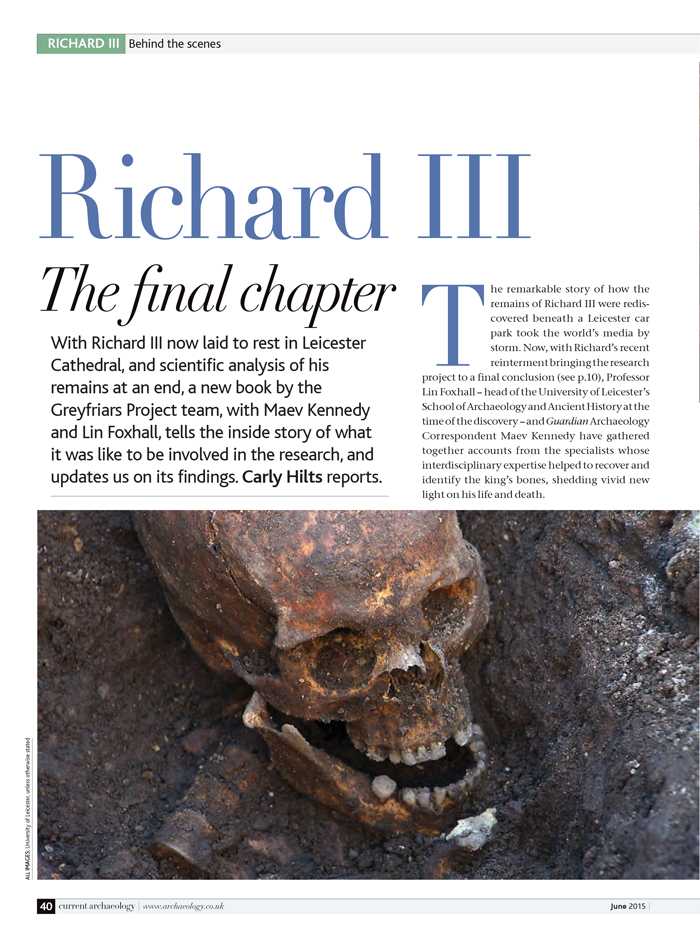
CA 303 (June 2015) picked up the next phase of the story: Richard III’s reburial, which took place with appropriate pomp and ceremony in Leicester Cathedral in March 2015. The coffin bearing his remains was first transported to Bosworth Battlefield, then carried through neighbouring villages back to Leicester, before a solemn service of reburial was conducted, with the king placed in a new vault close to the sanctuary at the east end of the cathedral, topped with a large tombstone. The story of the search for the now no-longer ‘lost king’ then moved into a different space and at a different pace, with the next report coming in CA 336 (March 2018), when the original burial site – and, in fact, a substantial part of Greyfriars – was scheduled. I was part of the team at Historic England who worked on this legal process to protect the site from future development, and it was a great moment to correct what felt like a historical wrong: many rural monastic sites have been scheduled, but urban friaries of this type have tended to be overlooked, hidden by later construction on their site until modern redevelopment brings them to light once more.
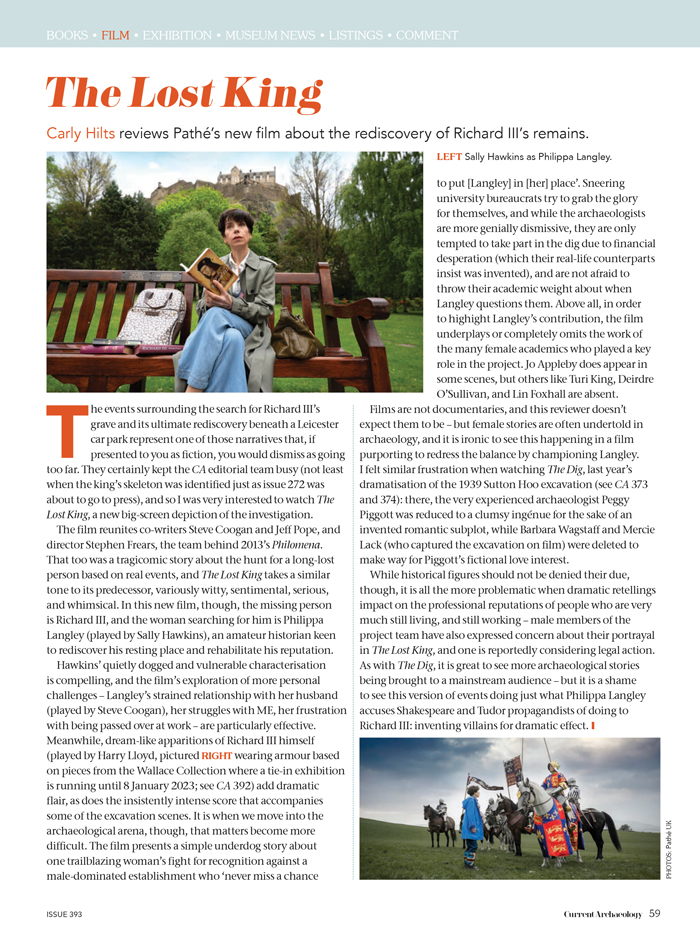
After a gap of nearly five years, CA 392 (November 2022) and CA 393 (December 2022) brought news of a new exhibition linked to a new film about Richard III, appropriately entitled The Lost King. The former was held at the Wallace Collection in London, home to a globally significant collection of arms and armour including much from Richard III’s era. The film, meanwhile, was a dramatic retelling of the story of discovery. It received mixed reviews in the media – including in Current Archaeology – and subsequently led to legal challenges about the portrayal of some of those depicted, although Current Archaeology did not report directly on that. A very different aspect of the still-unfolding tale of Richard III’s impact on modern-day society then came in CA 419 (February 2025), when the remains of more than 100 men, women, and children were discovered in a mass burial pit close to Leicester Cathedral during works for the new King Richard III Visitor Centre (see link below). Dating to the early 12th century, the working hypothesis is that these represent the victims of some sort of epidemic disease: samples taken at the time are being analysed by the Francis Crick Institute in London to identify traces of ancient pathogens, so a follow-up may well appear in a future edition of the magazine. But this is, at least for now, the most recent report in CA on the complex tale of the death, burial, loss, rediscovery, reburial, and reinterpretation of Richard III.
The three major sites in and/or near Leicester associated with Richard III are all regularly open to the public: the King Richard III Visitor Centre (https://kriii.com), Leicester Cathedral (https://leicestercathedral.org), and the Bosworth Battlefield Heritage Centre (www.bosworthbattlefield.org.uk). These can be usefully combined with a visit to the nearby Jewry Wall Museum, which examines the city’s rich Roman history (www.jewrywall.com), making an exceptional day in and around the city.