Life on the edge of Empire
What was the impact of Rome’s numerous attempts to conquer Scotland? A new exhibition in Edinburgh traces the experiences of soldiers, civilian inhabitants of frontier fort communities, and the local people whose lands they occupied. Fraser Hunter reports.
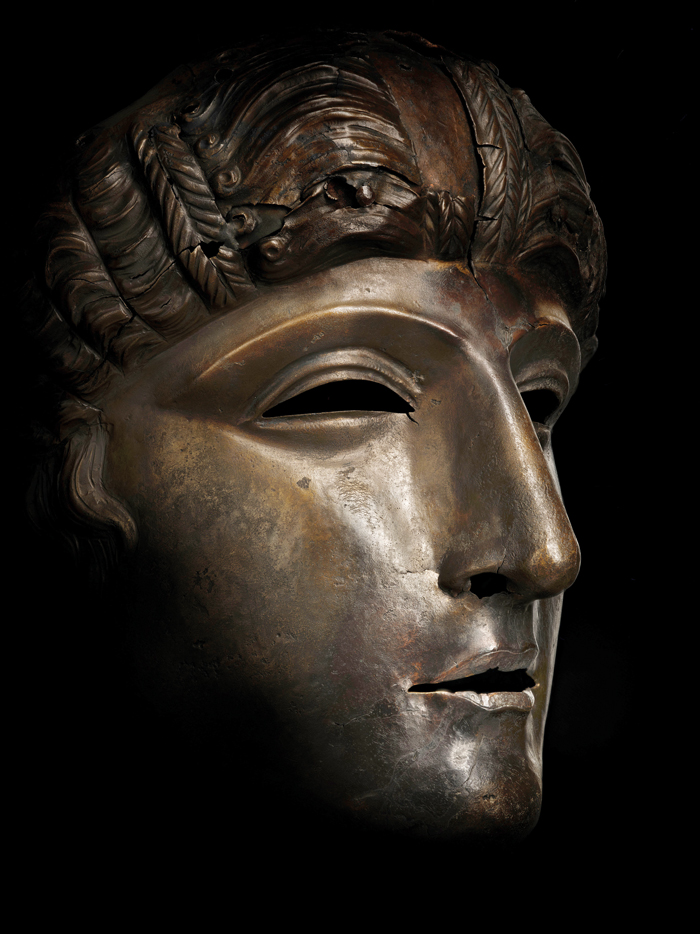
Also from Trimontium, this face mask – from a 1st-century cavalry parade helmet – is one of the most recognisable archaeological icons from Roman Scotland. IMAGE: © National Museums Scotland
Hadrian’s Wall forms a very permanent-looking statement of intent – a hard edge to Rome’s empire. Its dominance in the landscape today shapes people’s ideas of the Roman frontier in Britain, and overshadows Roman involvement with lands further north. The Wall was not meant to be where the Empire stopped. Three times Rome tried to conquer what is now Scotland, and three times they pulled back. A special exhibition at the National Museum of Scotland in Edinburgh reveals the story of these northern campaigns with new discoveries, recent research, and multiple loans from across Britain and the Continent. We will explore some of these themes here.
The exhibition is more than just a reminder of Scotland’s Roman past. It brings recent approaches in Roman frontier archaeology to a broader audience. The focus is not on the legionaries, Roman citizens from the Mediterranean, but on auxiliary troops recruited from all around the Empire who did the grunt work of holding down a difficult land. Yet the story of the frontier is about more than men with swords, and to understand it fully we must look beyond soldiers and consider the communities that travelled with them and built lives around them: people whose tales archaeology is uniquely well-placed to tell.
The Roman army did not simply march into an empty landscape. This land was already occupied by complex farming societies who had their own histories of connections and conflict with each other. In considering ‘Roman Scotland’, we must look at the impact of invasion on local societies, and how they reacted to these events. The multicultural Roman army was no UN peacekeeping force. It was bent on conquest and occupation, with troops willing to do whatever was needed to take this land for Rome.
AT THE EMPEROR’S COMMAND
Let’s start with some historical context. Our focus is on the first two Roman invasions of Scotland: one in the late 1st century under the governor Agricola, and the other in the middle of the 2nd century on the orders of the emperor Antoninus Pius. Agricola’s campaigns, which pushed deep into north-east Scotland, secured their place in history thanks to the survival of a biography written by his son-in-law Tacitus. It is a laudatory piece that sees nothing but the best in the general, and it has shaped perceptions of Roman Scotland. Since its rediscovery in the 15th century, scholars have viewed Roman Scotland through Tacitus’ eyes, seeking Agricola’s footsteps and chasing the location of the Battle of Mons Graupius, where Tacitus describes a crushing victory against local armies. Yet in his account of this climactic battle the locals have the best lines – Tacitus conjures up stirring words for a local war-leader, Calgacus, which have resonated through the ages: ‘They plunder, they butcher, they ravish, and call it by the lying name of empire. They make a desert and call it peace.’
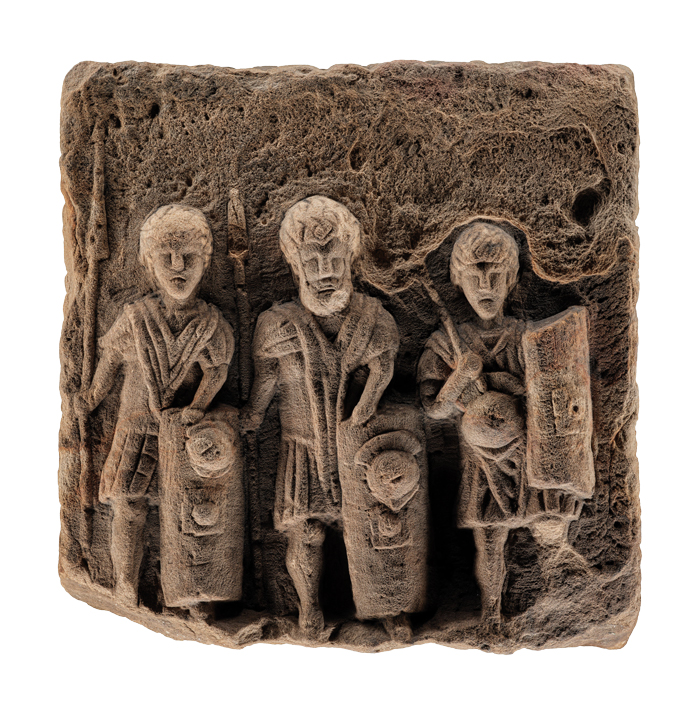
Rome may have won the war, but it lost the peace. Barely had forts been constructed than they were abandoned when the emperor Domitian ordered military withdrawal from Scotland. ‘Britain was conquered and immediately abandoned’ was Tacitus’ acid overstatement. The question of why Rome failed to hold Scotland has long been debated, with some seeing a lack of Roman desire and others a surfeit of local resistance, but in this instance the answer seems clear. Problems on the lower Danube threatened the heart of the empire, and pressing new priorities saw soldiers pulled out of Britain for service in a more troublesome region. The remaining army withdrew to northern England, to the line fossilised in stone by Hadrian. This was not to remain the edge of Empire.
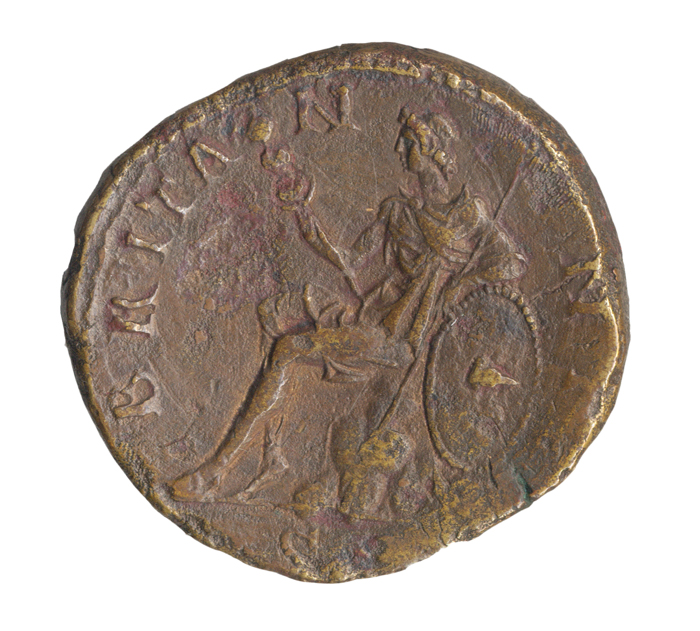
On Hadrian’s death in AD 138, his successor, Antoninus Pius, ordered the troops north once more, and constructed a new frontier fortification that still bears his name today. This deployment was long seen as a propaganda move to acquire a pedigree of triumph for a distinctly unmilitary emperor, but recent research suggests otherwise. Repeated upheavals during Hadrian’s reign continued to demand attention. The Antonine Wall, running across the narrowest part of Britain from Forth to Clyde, carried monumental sculptures laden with triumphal imagery. Coins were struck commemorating success and, for the only time in his reign, Pius took the title ‘Imperator’, a battle-honour translated as ‘commander’. This clearly meant something.
DEMAND AND SUPPLY
The roads that Rome built to hold down Scotland still shape our infrastructure today: the M74 in the west and the A68 in the east shadow Roman lines. A network of forts was also built during the two occupations, with clusters of fortlets in south-west Scotland indicating a particular trouble spot. Yet restless locals were only part of a commander’s concerns. Their own troops could be just as troublesome if not kept fed and watered. Complex logistics chains were required to supply the forts with a diverse range of resources that were requisitioned or grown locally, imported from elsewhere in Britannia and, for key materials like olive oil and wine, shipped from the Mediterranean.
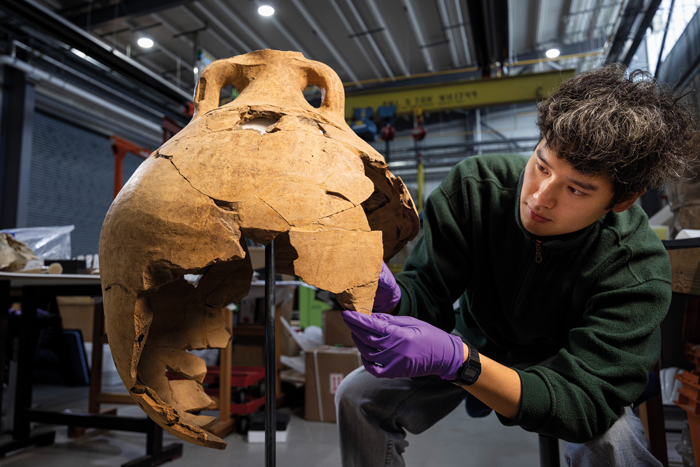
Examining the containers that carried some of these goods can yield intriguing clues. Painstaking conservation work has recently transformed a box of sherds recovered from the fort at Inveresk into a largely complete olive-oil amphora, sparking illuminating research into its origins. Specialists at Barcelona University were able to trace the stamp on its handle to the workshop of La Catria, between Seville and Córdoba in southern Spain, which was one of the mega-producers of this period. More unusually, strange markings on the vessel’s interior turned out be a stamp in reverse, left by an old amphora handle that had been used as a tool to beat the clay into shape. Detective work revealed that this, too, came from La Catria, but from a previous generation of pots, in a clear example of Roman recycling.
We see similar resourcefulness with a wine barrel from Inveresk that had survived in very good condition owing to its reuse as a well-lining. Originally standing over 1.7m tall it would have contained the equivalent of 1,400 bottles of wine, and the mixture of silver fir and larch in its staves suggests it came from the Rhône valley in southern France. Meanwhile, geological scrutiny and scientific analysis have identified two long-overlooked fragments from Castlecary on the Antonine Wall as the remains of vessels made from Egyptian basalt, extremely rare finds that must have been part of an officer’s baggage, reminding us that these far-reaching networks carried both staple supplies and luxuries.
This is an extract of an article that appeared in CA 441. Read on in the magazine, or click here to read it online at The Past, where you can read all of the Current Archaeology articles in full as well as the content of our other magazines, Current World Archaeology, Ancient Egypt, and Military History Matters.