Two decades of excavations in East Sussex farmland have uncovered the remains of an unusual enclosed settlement linking the Roman road network with the River Ouse. Rob Wallace and David Millum explain more.

North of Lewes in East Sussex, the Upper Ouse Valley is home to an archaeological landscape rich with Roman remains, including evidence of industrial and agricultural activity, field systems, roads, and a winged corridor villa with a free standing bathhouse. It was in order to investigate the wider historical environment around this last site (which was excavated by UCL and the Mid Sussex Field Archaeological Team in 2000-2007) that Rob Wallace founded the Culver Archaeological Project in 2005. Since then, under Rob’s direction and the supervision of qualified archaeologists, this volunteer community venture has been exploring the parishes of Barcombe and Ringmer, offering illuminating insights into the area’s Roman past. The support of the landowners, the Stroude family, has been vital for the project’s success: CAP simply could not exist without the kind permission of Harold (now deceased), Meg, and Mark to investigate on their farms, and we cannot give enough credit and appreciation for their inside knowledge of this landscape. So, with the project celebrating its 20th birthday this year, what have been some of its key discoveries?

CAP’s story begins at Culver Farm, Barcombe, which was the focus of its first phase of work between 2005 and 2010. There, what was then only a small team carried out trial-trenching, geophysical surveys, and open-area excavation within several fields, revealing diverse Roman features – the most substantial and most significant of which was a previously unknown road running down the west bank of the River Ouse. Two sections of this route were initially investigated in neighbouring fields: one in Culver Mead (where, in 2006, the team also discovered three waterlogged timbers that were later radiocarbon dated to AD 240-430), and the other in Pond Field, to the south, where excavations ran from 2007 to 2010.
This work revealed that the road was made up of large flint nodules, with a cambered surface sloping down to ditches on each side, and the excavations uncovered evidence, too, of roadside industrial activity, indicated by pits, ditches, post-holes, and areas of burning. In Pond Field, though, the team found evidence of much earlier occupation as well: a Middle Bronze Age cremation, contained in a small, plain urn stylistically dated to c.1500-1000 BC. Three more possible cremations were identified nearby, lacking urns but represented by patches of charcoal and burned bone. Then, in 2009, the project’s focus shifted south once again, examining a continuation of the same road in Court House Field – although in this area we could see a clear kink in the route’s line, possibly deviating from its course due to the need to cross a palaeochannel. And there was still more to come: during this period, we were able to borrow both an earth resistance meter and a magnetometer, which allowed us to trace the road even further, following it as it skirted east of the villa complex and headed south towards the Downs at Offham.
ROAD TO THE PAST


It was this interest in the area’s Roman infrastructure that led us across the river to Bridge Farm, on the eastern bank of the Ouse, in 2011. Our initial aim had been to carry out a geophysical survey to plot the course of the Roman road from London (RR14) that had been discovered by Ivan Margary in the early 1930s. As the work (carried out with local geophysicist David Staveley) progressed, however, it soon became clear that the fields at Bridge Farm contained a great deal more than just a Roman road. We could see the route’s flanking ditches very clearly in the digital image produced by the survey, but there were two much larger ditches slicing across their northbound course as well. What were they for? Several more days of magnetometry provided the answer, revealing the characteristic round-cornered square of Roman defensive earthworks, bounded by double ditches and surrounded by field boundaries, with a very busy interior. At the north-east corner, we could see the London Road entering the enclosure to join an interior route running east–west, while a smaller road was visible too, running south through the centre and continuing beyond the enclosure towards the River Ouse.
Systematic field-walking and metal-detecting surveys, organised by CAP in 2012, recovered artefacts that confirmed the Roman date of these features, and further geophysical surveys by David Staveley have been able to establish the course of more of the eastbound road. We can now trace its route through Ringmer to the Roman settlement at Arlington, and on to the Saxon Shore fort at Pevensey. Bridge Farm appears to have been an important junction on the east west road from the regional capital at Noviomagus Reginorum (Chichester), linking it both with the London Road and a stretch of the River Ouse that was, at that time, navigable all the way to the coast. This network of connections would prove vital to interpreting what was already emerging as a rather unconventional settlement.

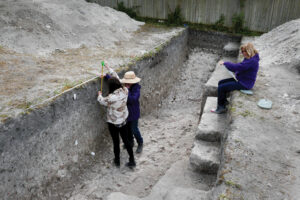
Our investigations gained a boost in 2013, when CAP secured a National Heritage Lottery Fund grant to carry out a one-year community excavation – support that allowed us to commission AOC Archaeology to assist in managing the large investigation, which was to be spread over four trenches. A key condition of the funding was to actively encourage members of the public and local schools to engage with their heritage, and happily there was no lack of willing participants. In our first season alone, 180 volunteers and 150 schoolchildren took part in the excavations, while over 400 people visited the site during the dig, and 500 attended talks by specialist archaeologists. This community aspect continues to be a key part of the project and is actively promoted every season, even as CAP expanded since those early days. We still encourage local people to discover the archaeology of the landscape in which they live, but CAP now also offers practical training to both volunteers and university undergraduates. The dig runs for six weeks every summer, and it includes a four-week course covering all the basics of archaeological fieldwork (see https://www.culverproject.co.uk).
This is an extract of an article that appeared in CA 423. Read on in the magazine, or click here to read it online at The Past, where you can read all of the Current Archaeology articles in full as well as the content of our other magazines, Current World Archaeology, Ancient Egypt, and Military History Matters.