Roman tile production in the north Wiltshire countryside
A community excavation in the small village of Minety has found a Roman tile kiln, which marked its products with a series of stamped letters. As the investigation, led by Cotswold Archaeology, revealed, this industry was of more than just local importance – and with another season of digging set to take place this summer, Neil Holbrook and Peter Warry report on the story so far.

Tiles and bricks, collectively known as ‘ceramic building material’ (CBM for short), are ubiquitous finds on many Roman sites. Indeed, it is precisely because of this abundance that many 20th-century archaeologists took little interest in CBM. Excavators frequently the bulk of the seemingly uninteresting fragments with only cursory examination at best. An exception to this rule, however, was tiles that had been impressed with stamped letters before they were fired. These have long been of interest to antiquarians and modern archaeologists alike, as they can provide illuminating clues about the industry that produced them. For instance, tiles found in Roman forts are sometimes stamped with the name of the army unit that made them, while civilian tile stamps give the names or codes used by certain municipal or private tileries.


Six different tile stamps have been identified among the Brandier Farm finds: they read TPF, TPFA, TPFB, TPFC, TPFP, and LHS
Civilian stamps were never common in comparison to military ones. They were used on the products of municipal tileries in London and Gloucester, but virtually nowhere else; as for privately operated kilns (which served both urban and rural projects), fewer than 500 examples of their stamps are known from the whole of Britain. Two-thirds of all stamps issued by private tileries have been found in Gloucestershire and north Wiltshire, so here, uniquely in Roman Britain, we have a better chance than anywhere else of gaining insights into the organisation of the civilian tile industry during this period.
Around ten or so different letter groups can be distinguished in the Cotswold region, and sometimes a series of different dies (objects made of wood or metal in which lettering has been engraved so as to produce a stamp when the die is impressed in the wet clay of the unfired tile) produced the same basic letter stamp. Only a very small proportion of the output was stamped, perhaps just a few tiles per firing, and the two most common stamps that we see use the letters LHS and TPF (together with derivations of the latter: TPFA, TPFB, TPFC, and TPFP). TPF could stand for T(egularia) P(ublica) F(ecerunt) or T(egulariorum) P(ublicorum) F(iglinae), both of which can be translated as meaning ‘made by/product of the public tileworks’. Alternatively, TPF could just be the initials of the tilery’s owner, as is presumably the case with LHS.


The vast majority of LHS and TPF tiles (96 out of 150 known examples) have been found in Cirencester, but where were they made? For many years, the source was thought to be a site called Oaksey Park, near Minety in north Wiltshire, which lies just six miles south of Cirencester. This was largely hearsay, though, based on the supposed findings of an excavation of two kilns and associated features by amateur archaeologist Anthony Scammell in the early 1970s – and which contradicted what Scammell himself had actually written about the site. The results of the excavations were never published, but Scammell did lodge a report with Devizes museum in which he is quite clear that he did not believe the stamped tiles had been made in the kilns he had investigated. This has now been confirmed by the results of a community archaeology project led by Cotswold Archaeology at another Roman tile kiln in Minety at Brandier Farm, just over a mile from that at Oaksey Park.

The Brandier site had attracted little previous attention, but when photographer and ceramicist Peter Lavery and his family bought the farm in 1992, Peter noticed a distinct mound in one of his fields, and around it he found fragments of heavily fired Roman tile. Peter was keen to see the mound investigated in more detail, and in 2022 Cotswold Archaeology instigated a project to learn more about it. A preliminary geophysical survey showed evidence of intense burning within the mound and surrounding area, and this led to two seasons of excavation, with a third and final season this summer.
When our project began, our initial hopes were to establish whether there was indeed a Roman tilery at Brandier, as opposed to some other type of industrial activity such as a medieval pottery kiln (Minety was the centre of an important ceramics industry during that later period, so it was possible). And if it was a Roman tile kiln, how did it relate to the Oaksey Park site? Was it contemporary, indicating a more dispersed industry in the Minety area than hitherto had been realised, or did Brandier replace its neighbour? We were also excited by the chance to investigate a tile kiln under modern conditions, and to apply scientific techniques to understand more about the fuels used to fire it and
the environment in which it had stood.
A New Roman Tile Kiln
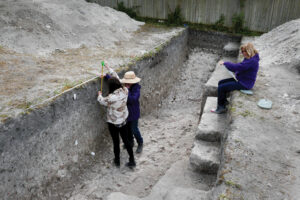
We began by targeting Trench 1 on the area of high magnetic response at the northern end of the mound. Within a couple of hours on the first day of the dig, it became apparent that we did indeed have a Roman tile kiln – and we were also greeted by our first stamped tile, which, appropriately, could be read as ‘HI’ (in reality, it was a fragment of a rather more conventional LHS stamp). The kiln itself (termed Kiln 1), was made from brick and tile; its central flue, stoke hole, and the southern part of the firing chamber were well preserved, while the northern part was much less so, although enough survived to show that the original chamber measured c.5.4m by 4.8m. The flue had been kept dry by a drain formed from curved tiles, and we could also see that Kiln 1 had been repaired on several occasions. The wall of the firing chamber had been rebuilt with clay-bonded bricks that survived up to eight courses high, and the central flue had also been relined and made narrower, perhaps because the original design had not functioned overly well. A line of post-holes just beyond the back of the stoke-hole either formed a standalone structure such as a drying shed, or supported a canopy roof to protect the kiln from the elements.


We did not recover any dating evidence associated with Kiln 1’s construction: the little pottery from the demolition layers is no earlier than the middle of the 2nd century AD – but there are strong suggestions that this was not the first kiln to operate on the site. Beneath the southern chamber wall, two other tile walls were found at a lower level with vitrified internal faces. They may have formed the flue of an earlier kiln (Kiln 2), and we will investigate this area further in this summer’s dig – so watch this space for further updates on that later in the year. We identified a large clay-extraction pit, too: 3m deep, close to kiln 1. Its lowest fills were waterlogged and contained preserved timber planks; above this, the pit was backfilled with kiln rake-out, waste tiles, and fragments of vitrified kiln wall.
This is an extract of an article that appeared in CA 413. Read on in the magazine, or click here to read it online at The Past, where you can read all of the Current Archaeology articles in full as well as the content of our other magazines, Current World Archaeology, Ancient Egypt, and Military History Matters.