Excavations at Carlisle Cricket Club are uncovering the remains of the largest Roman building ever found on Hadrian’s Wall. Carly Hilts visited the site and spoke to Frank Giecco to find out more.

The story of Roman Carlisle is a tale not of two cities but of two forts. Having brought much of southern England under imperial control in the years after the Claudian invasion of AD 43, in the AD 70s the Roman army surged north, annexing swathes of new territories and consolidating these gains by building forts within them.
One such military base was at Carlisle, positioned to guard the junction of two major Roman roads – one running east west on a line that, half a century later, would be fortified by Hadrian’s Wall, and the other heading north into modern Scotland – as well as the confluence of the Rivers Caldew and Eden. Today this site is covered by Carlisle Castle, but excavations have explored some of the fort’s remains (see CA 101, CA 164, and CA 183), and surviving timbers confirm that it was founded c.72-73.

A civilian settlement soon grew up around the fort (CA 353), and Luguvalium Carvetiorum – named after Lugus, a local god whom the Romans equated with Mercury, and the indigenous Carvetii people – flourished into an important border town, and a vital administrative and supply hub. The fort continued in use after Hadrian’s Wall was constructed a short distance to the north in AD 122, but, as part of these new defences, a second fort was built on the opposite side of the Eden. This was Uxelodunum (Stanwix), the largest fort on Hadrian’s Wall, which was home to a 1,000-strong auxiliary unit known as the Ala Gallorum Petriana – the only cavalry unit of its size documented in Britain.
These two garrisons bracketed a landscape of intense military activity, but this was not simply a buffer zone on a contested border. Just 400m south-west of Uxelodunum, and within around 250m of the presumed site of Milecastle 66, evidence is emerging of an enormous and very grandly appointed building – the largest building yet identified on Hadrian’s Wall – which would have been a dominating feature of the local landscape. Why was such a sumptuous structure built in a relatively remote part
of the Roman Empire?
FRONTIER FINDS

Today, the building’s remains lie in rather more genteel surroundings, beside the smooth green lawns
of Carlisle Cricket Club. Despite the structure’s impressive scale, its presence was unknown until an inconvenient episode in the Cricket Club’s history presented a unique archaeological opportunity. Some years ago, the River Eden burst its banks, flooding the club’s pavilion. Constructing a replacement so close
to Hadrian’s Wall required careful consideration of the potential impact on any underlying archaeology, and so in 2017 Wardell Armstrong were commissioned to carry out an evaluation on the proposed site. The archaeological potential of this location was exciting – and the team, who were led by Frank Giecco,
were not disappointed.
Their initial evaluation uncovered unmistakable evidence of a Roman hypocaust system, indicating the presence of a bathhouse or another building with heated rooms, as well as quantities of animal bone, pottery, and metalwork. A particularly intriguing find, however, was a fragmentary inscription referring to Julia Domna: the wife of one emperor, Septimius Severus (r. 193-211), and mother of two more, Geta (d. 211) and Caracalla (d. 217). Significantly, Severus and his family are known to have visited northern England: although Britannia was a small province on the edge of the Roman world, between AD 208 and 211 the entire empire was ruled from York (Eboracum) after the imperial household took up residence. The reason for this relocation was Severus’ ambition to bring the unconquered lands north of Hadrian’s Wall under Roman control, and during these campaigns, the late Roman Historia Augusta attests, the emperor visited a mansio, a grand official stopping place, while inspecting the Wall. Could Severus have travelled to the empire’s northernmost border town as part of his invasion plans? This might explain why Roman Carlisle gained civitas (regional capital) status in the early 3rd century, and why the town underwent an intense period of rebuilding at around the same time. Could the construction of a monumental building just across the river also be linked to the prestige of an imperial visit?

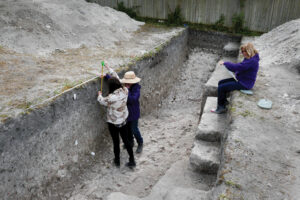
There was clearly much more to learn about the site, and – following a successful National Lottery Heritage Fund bid – regular excavations have been running there since 2021. Still directed by Frank Giecco, the community project is a partnership between Wardell Armstrong, Carlisle Cricket Club, Cumberland Council, and Tullie House Museum & Art Gallery, working with an army of volunteers aged 8 to 80. Each new phase of their investigations adds to our understanding of what was clearly an impressive and high-status building. Although its stonework was plundered during the medieval period, surviving wall remains and the size of later robber trenches testify to the scale of what once stood on the site. Its full extent is yet to be established, but the building’s footprint covered at least 50m by 60m, over five terraces. As we will explore later, among the more-than 5,000 small finds that have been recovered to-date, there are echoes of distinctly wealthy visitors to the site, and possible links to the imperial court itself.

The structure was originally interpreted as a very grand bathhouse, but as more of its plan has been
reconstructed, and as more high quality artefacts emerge, suggestions of something more significant are becoming stronger. Was this an exclusive facility enjoyed by the most privileged members of the nearby Uxelodunum community? A luxurious residence for the fort’s commander? Or, given the building’s early 3rd-century date, could it be connected to Severus’ travels within northern Britain?
This is an extract of an article that appeared in CA 418. Read on in the magazine, or click here to read it online at The Past, where you can read all of the Current Archaeology articles in full as well as the content of our other magazines, Current World Archaeology, Ancient Egypt, and Military History Matters.