Examining a new addition to the Hadrian’s Wall ‘souvenir’ vessels
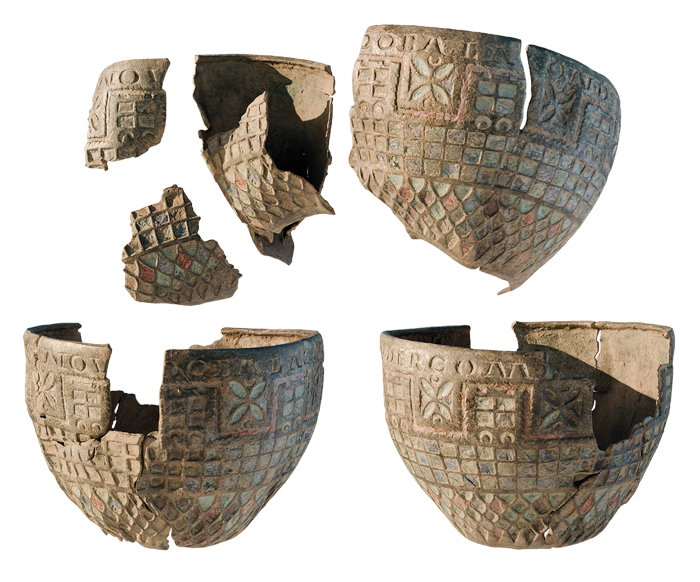
The fragments making up the remains of the Berlanga Cup (top pair of images) and (below) a digital reconstruction of the artefact. Recently found in Spain, it is the latest addition to the ‘Hadrian’s Wall vessels’. IMAGE: 3D Stoa. Arqueología y Patrimonio
Over the last 300 years, a handful of enamelled bronze vessels, most of which are thought to depict Hadrian’s Wall and in some cases are inscribed with the names of forts along its line, have been discovered in Britain and on the Continent. With a sixth example newly unearthed in Spain, Carly Hilts explores what these 2nd-century ‘souvenirs’ can tell us about Roman responses to their northern frontier.
Housesteads. Birdoswald. words are familiar to us as the names of forts along Hadrian’s Wall – but if you said them to a Roman soldier, you would be met with blank incomprehension. We have few contemporary written sources to tell us what these fortifications were called by the troops who garrisoned them, as most inscriptions from such sites name the resident unit and/or their commanding officer rather than their location. There are some rare exceptions, however. Thanks to the unusual wording of sandstone altars from Birdoswald and Housesteads (RIB 1905 and RIB 1594), we can deduce that they were respectively called Banna and Vercovicium. For the names of many others, though, we must turn to late Roman or even early medieval sources: the Notitia Dignitatum (a 4th-century administrative document), and the Ravenna Cosmography (a list of places compiled c.AD 700, based on a now-lost map). The date of these writings, however, and the fact that they have come down to us as copies preserved in late medieval manuscripts, mean that the nomenclature that they supply should be used with careful caveats.
There is another, rather more contemporary body of evidence to help confirm some of these names, however: a handful of small, bronze vessels dating to the 2nd century. Found scattered across England, France, and Spain, they are variously described as ‘cups’, ‘pans’, and ‘skillets’, or using the Latin terms trullae and paterae. Each has vibrant enamel decorations, most of which depict a stylised image of a turreted wall, and some of them also bear the names of forts featured in the manuscripts described above (albeit with some variations in spelling). With the discovery of a sixth member of this enigmatic group recently announced in the journal Britannia, this is a good opportunity to explore what they can tell us about Roman perspectives on the Empire’s northern frontier.
A COLOURFUL COLLECTION
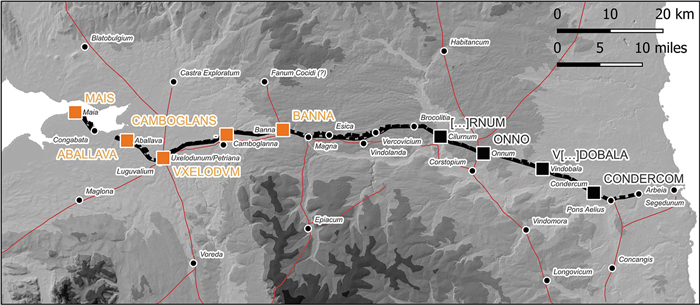
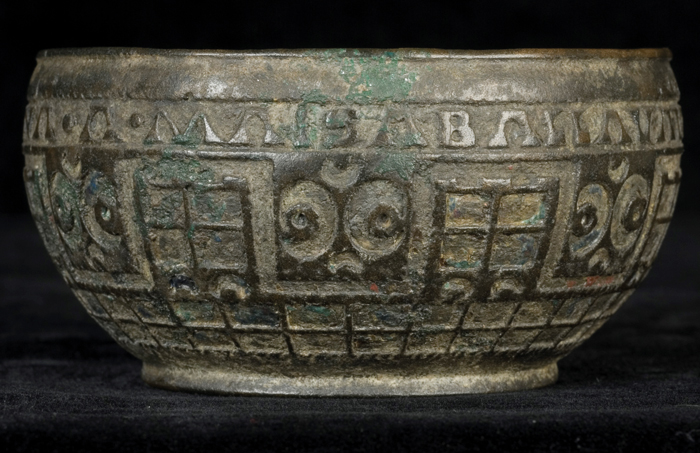
The first artefact in this group is the Rudge Cup, which was found around 400km (250 miles) from Hadrian’s Wall in Rudge Coppice, near Froxfield in Wiltshire. It was discovered in 1725, during the excavation of a presumed Roman villa (the investigations uncovered the remains of a building with a fine mosaic floor), not within the structure itself, but in a nearby well whose unusual contents included coins, animal bones, and a number of human skeletons, perhaps speaking of a ‘special’ deposit. Now housed at Alnwick Castle in Northumberland, the cup measures around 4.6cm (1.8in) tall and around 9.4cm (3.7in) in diameter. Traces of red, green, and blue enamel survive on its surface, including a regular, geometric pattern depicting a crenellated wall, outlined in red and filled with small squares evoking regular blocks of stone. Most significantly, it also has the names of five forts from the western end of Hadrian’s Wall moulded in relief just below its rim: Mais (Bowness), Aballava (Burgh by Sands), Uxelodunum (Stanwix), Camboglanna (Castlesteads), and Banna (Birdoswald).
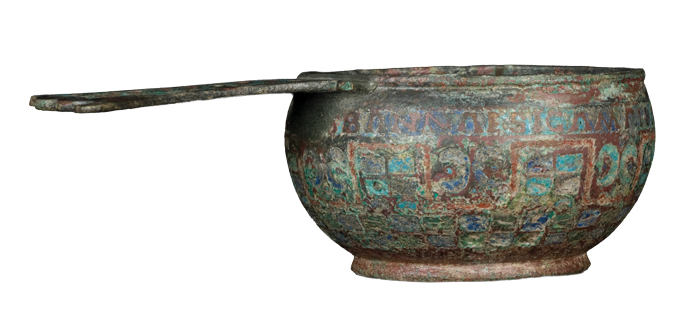
For more than 200 years, the Rudge Cup remained an intriguing anomaly – but in 1949 a strikingly similar artefact emerged from the soil, this time in Amiens, northern France. It was associated with a Gallo-Roman house, and was found in a room with a hypocaust, alongside a pipeclay goddess figurine. This artefact is slightly larger than the Rudge Cup, and as it has a handle (albeit found broken off); it is known as the Amiens Skillet. Despite the distance between their findspots, both are strikingly similar in design. The Amiens artefact (now in the collections of the Musée de Picardie) also has a red enamelled line tracing the same mural motif, with a chequerboard of ‘masonry’ squares picked out in green and blue underneath, and both vessels use the same image of back-to-back crescents and dots to fill spaces between the crenellations. Again, we see moulded text beneath the vessel’s rim, preserving the same five fort names as appear on the Rudge Cup – but here there is a sixth, too: Aesica (Great Chesters).
Scholars would not have to wait so long for a third example to be found. Numerous artefacts have been recovered from the sacred thermal spring that rises beside the courtyard of the Temple of Sulis Minerva in Bath and feeds the site’s famous Roman Baths – and in 1980 these included another vessel with a mural design. The Bath Pan is similar in size to the Rudge Cup, with a (broken) handle like the Amiens Skillet, and turreted decorations in common with both objects (albeit inverted). There is no inscription, though lettering had been added to the handle at a later date, picked out in tiny punched holes. The surviving text suggests that it was a dedication to Sulis Minerva, the site’s presiding syncretic deity, who combines the local goddess Sulis and the Roman goddess Minerva.
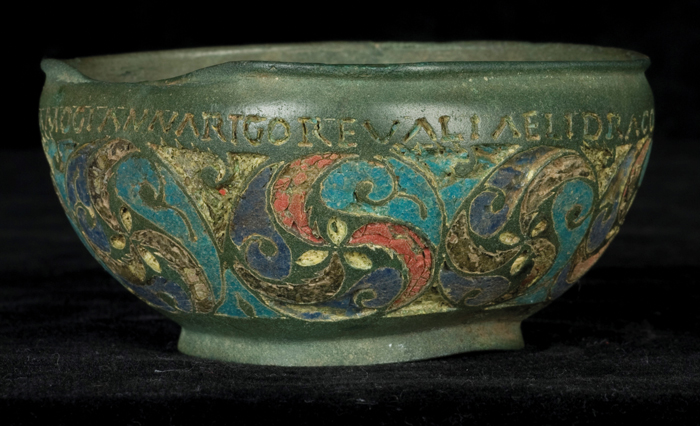
A blending of British and Roman traditions is extravagantly represented on the fourth vessel within this set, too. In 2003, a metal-detectorist discovered a particularly vibrant artefact while searching near the Staffordshire village of Ilam (see CA 188). Known variously as the Staffordshire Moorlands Pan and the Ilam Pan, its dimensions are again similar to the Rudge Cup, and, while it has no surviving handle, a patch of solder hints that one may have originally been present. This artefact bears the names of four frontier forts, and while some – Mais, Uxelodunum, and Camboglanna – are familiar from the other vessels, here a new name, Coggabata (Drumburgh), appears second, in place of Aballava.
Significantly, the inscription includes four additional words: Rigore Valli Aeli Draconis. The meaning of the first two is clear enough: vallum is used to refer to Hadrian’s Wall in the Notitia Dignitatum, which lists the frontier forts under the heading per lineam valli, ‘along the line of the frontier’. Rigore valli is thought to express the same idea – and it is possible that the pan also preserves the Roman name for Hadrian’s Wall itself. Aelius was the Emperor Hadrian’s family name (in full, he was Publius Aelius Hadrianus), and Valli Aeli could refer to ‘the Aelian frontier’, in the same way that we have Pons Aelius, ‘the Aelian bridge’, at Newcastle-upon-Tyne. Draconis, meanwhile, probably indicates that the pan was made or owned by a man called Draco (or Aelius Draco, if following another possible reading of the text).
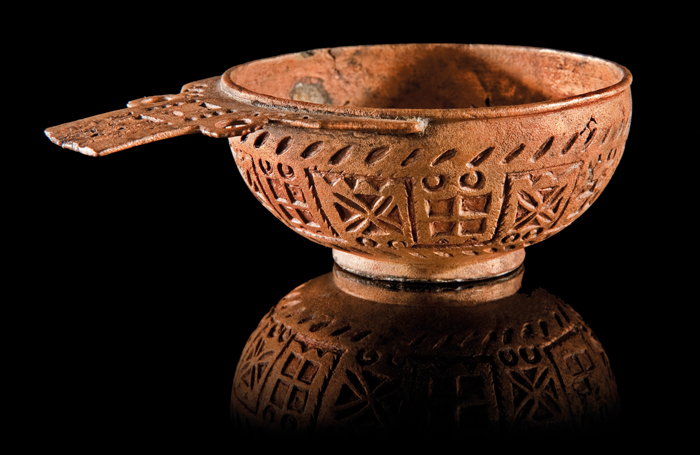
Another, more obvious difference is found in the pan’s decoration. Unlike the vessels described so far, this one (whose ownership is shared between the British Museum, Tullie in Carlisle, and the Potteries Museum and Art Gallery in Stoke-on-Trent) does not depict the Wall. In stark contrast to the sharply geometric designs of the others, the Ilam Pan is adorned with elaborate, swirling, Celtic-style patterns in red, blue and green enamel, creating an intriguing mix of distinctively local artistic ideas and text that evokes sites associated with imperial authority. Its exuberant design fits well into the tradition of highly skilled enamellers known to have been operating in Roman Britain (CA 222). Excavated finds show that colourful patterns were being applied to an eclectic array of objects, from flasks and jugs to dragonesque brooches (CA 311) and cockerel figurines (CA 381). This industry is thought to have been particularly associated with workshops in northern England, and Carlisle has been suggested as a possible production centre – one that, of course, lies on the line of Hadrian’s Wall.
Perhaps the most important difference between the Ilam Pan and its neighbours, though, is in the way that its inscription was created. Whereas the text on the Rudge Cup and Amiens Skillet was cast as part of the vessels’ original design, the fort names on the Ilam Pan had been incised later, with each letter cut deeply into the metal before being filled with enamel. This suggests that, while the first two objects had been deliberately designed to commemorate the Wall in some way, the Ilam Pan was a general-use (if rather flamboyant) object that was later customised to serve the same purpose.
This is an extract of an article that appeared in CA 436. Read on in the magazine, or click here to read it online at The Past, where you can read all of the Current Archaeology articles in full as well as the content of our other magazines, Current World Archaeology, Ancient Egypt, and Military History Matters.