Interpreting evidence of conflict from the Neolithic to the coming of the Romans
© National Museums Scotland
Interpersonal violence has been a fact of human existence for much of our long history – but how far is this reflected in the archaeological record? With a major new exhibition now open at the National Museum of Scotland, Matthew G Knight and Hannah Boddy examine traces of past conflicts spanning 4,000 years, and consider how to present these stories to modern audiences.
Bloodshed and warfare are all too familiar to us today. We think of wars fought by armies and nations, of conquests and invasions, of weapons of mass destruction. But the origins of war and the devastating effects that accompany it have deep roots that stretch back into prehistory. A new exhibition at the National Museum of Scotland in Edinburgh, entitled Scotland’s First Warriors, draws on archaeological evidence from Scotland to explore the nature of early conflict and violence from the Neolithic to the Roman Iron Age. This evidence is highly variable, represented at different times by numerous bladed weapons, fortifications scattered across the landscape, and the remains of people who suffered traumatic injuries.
Scotland’s First Warriors takes a broadly chronological approach, focusing on each period in turn, though with a strong emphasis on developments during the Bronze Age, notably the invention of the first specialised weapons. The exhibition invites visitors to think about the people behind prehistoric conflict, too, rather than imagining it as a straightforward technological development of longer and sharper blades. Conflict and violence did not happen in a vacuum, and their social consequences were wide-ranging and long-lasting. For every sword or spear displayed in a case, there were craftspeople making weapons instead of tools, individuals spending time training instead of farming, and communities whose fate lay in the hands of warriors.
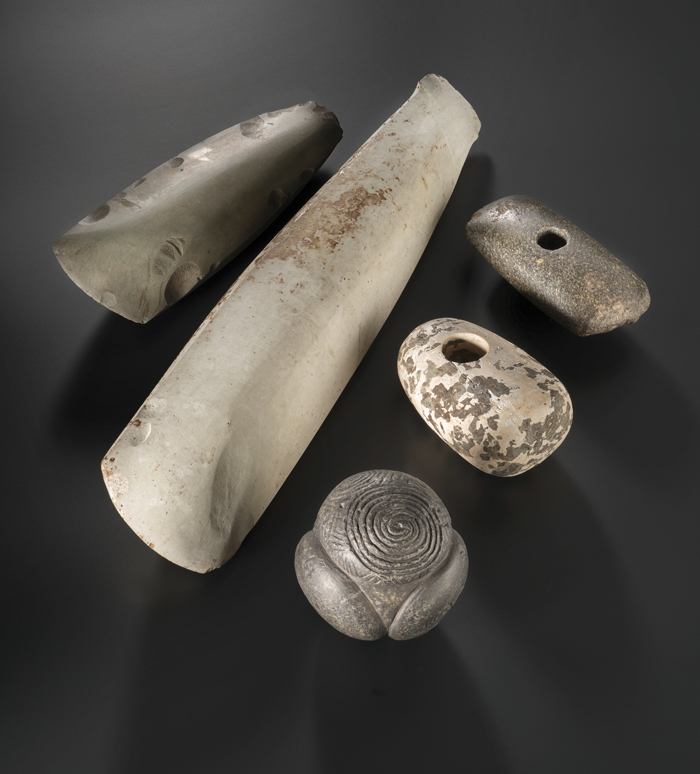
TRAUMA IN NEOLITHIC TOMBS
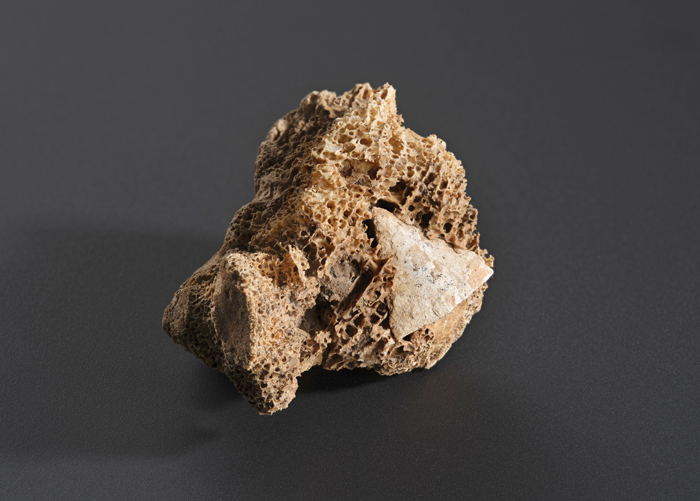
There is mounting evidence for conflict and violence during the Neolithic period in Europe. In Scotland, this is represented by the remains of people buried in chambered tombs who show signs of fatal injuries. Intriguingly, these discoveries are highly localised, being associated with several tombs on Orkney, as well as in Caithness on the northern tip of the Scottish mainland. The numbers of individuals with evidence of fatal or healed wounds are much higher in Orkney than elsewhere, affecting men, women, and children alike. Some preserve the marks of sharp-force trauma from axes or arrows; others have blunt-force trauma, perhaps from maceheads or carved stone balls. These objects were originally conceived for other purposes, such as hunting or tree-felling, but each could be turned to violent means if required. A particularly evocative example is a human vertebra, found in a chambered tomb at Tulloch of Assery, Caithness, which has a flint arrowhead still embedded in it. This person was shot in the spine. Does the arrow reflect a hunting accident? Or was it fired in anger?
THE FIRST BRONZE BLADES
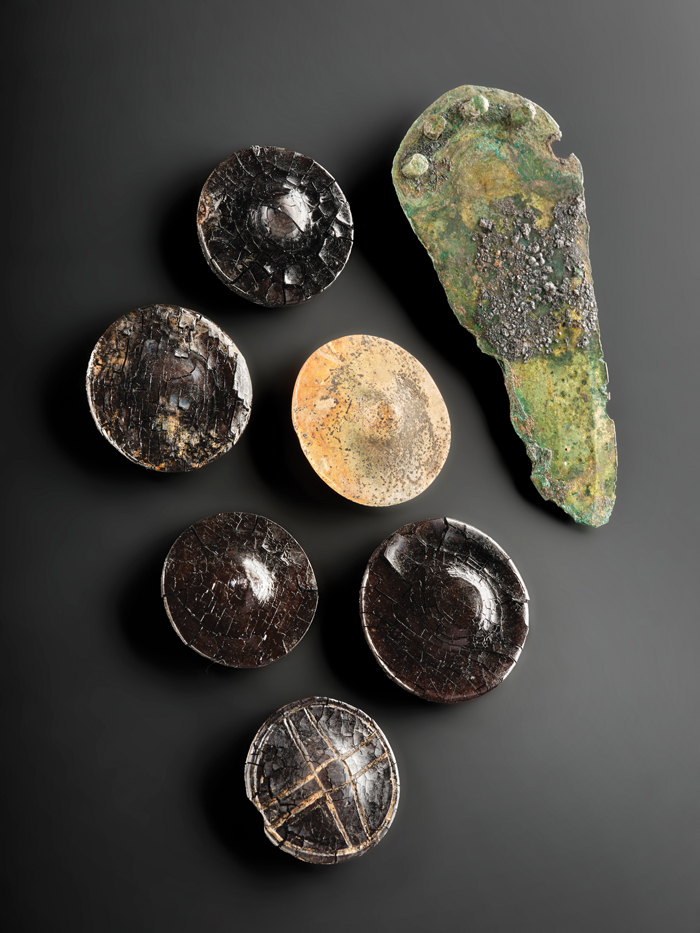
In the earlier Bronze Age, too, we must face the ambiguity of evidence. The inception of metalworking technology around 2450 BC allowed new metal axes and daggers to develop, alongside large, perforated stone tools. Do these reflect violent preoccupations? It is common to interpret people buried with daggers as ‘warriors’, but their graves often include a range of other material, such as pottery and jewellery. At Rameldry, Fife, a young adult male was found in a cist with a sheathed bronze dagger. He had been buried in clothing adorned with five jet buttons and one made of stone. One of the jet buttons was inlaid with tin – an exceptional preservation, and one that suggests this was either a well-travelled individual or someone who had access to extensive trade networks. Apart from the presence of the dagger, there is nothing to suggest that this person had ever engaged in conflict. Indeed, across the Bronze Age in Scotland, we very rarely see any other signs of warrior-related activities, such as evidence of trauma, preserved on the skeletal remains.
Nonetheless, this is the period that saw the development of the halberd, a copper or bronze blade hafted at a right angle to a long shaft. These objects occur in varying numbers across north-western Europe, and they have long been considered as ceremonial weapons, though archaeological experiments with replicas have highlighted their effectiveness at piercing animal bone. Wear analysis, too, has indicated that many may have been more intensely used than previously considered.
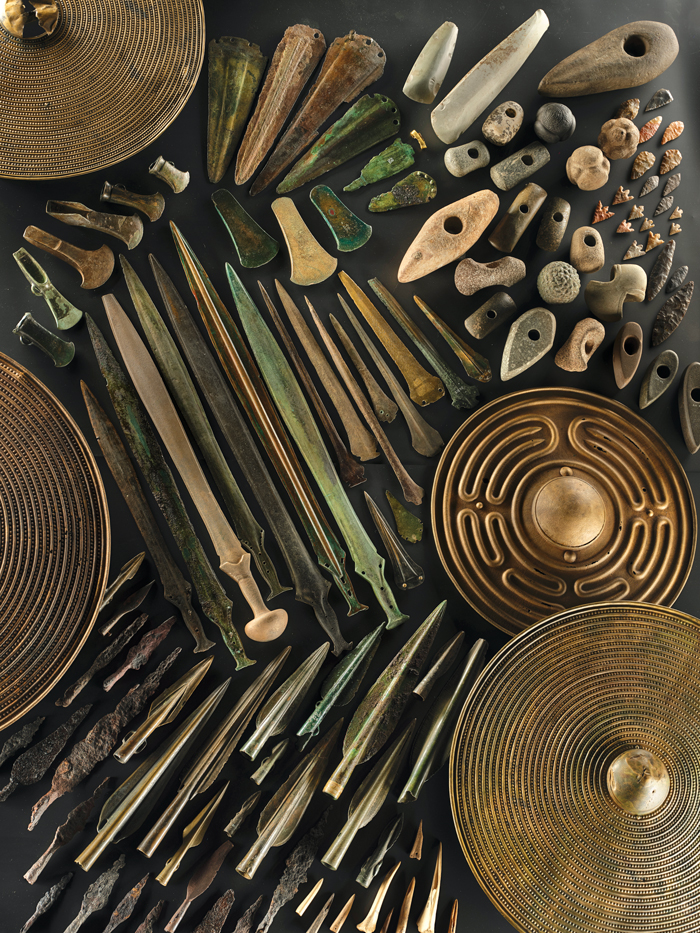
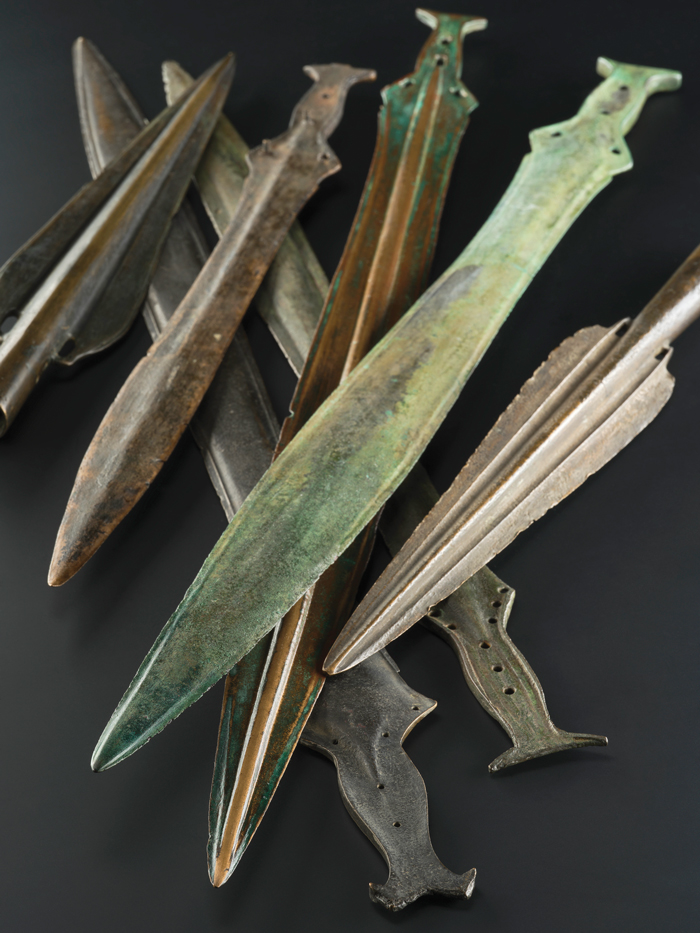
By the mid-2nd millennium BC, though, unambiguous metal weaponry was increasingly present. Earlier daggers transformed into longer and slenderer blades, known by the archaeological misnomers ‘rapier’ or ‘dirk’. These preceded the evolution of the first true swords in Britain, with a ‘leaf-shaped’ blade and integrated hilt on to which a handle was riveted. This development marks a significant shift within human history. Swords were the first weapons developed with the sole intent of harming another human – they had no other function as a hunting weapon or a farming tool – and they were produced in their thousands.
BEYOND THE SWORD
This generalisation of technological and typological development across several hundred years is the most common way that Bronze Age weaponry is presented. However, we should not forget the range of societal implications that come with these innovative implements. The invention of the sword indicates that conflict was such a necessary preoccupation that it required a dedicated object. Moreover, people were sufficiently fearful of violent encounters that it was worth diverting resources away from other occupations and crafts (for example, farming and pottery-making) to allow the production of offensive and defensive weapons. It is easy to overlook the fact that a sword in a museum case represents substantial metal resources invested in a weapon rather than a tool (the metal weight of one sword might equal three potential axeheads). Craftspeople had to refine their skills in making weaponry, and those who took up arms had to spend time training with them. It can take months, if not years, to become proficient in using a sword or spear effectively.
The same need for weapons (and those equipped with them) also prompted the rise in defensive equipment. Bronze cuirasses, helmets, and greaves have been found in parts of Europe, but, so far, no body armour of this period has been discovered in Britain – we must assume that organic counterparts were used. About 50 bronze shields have been found in Britain, though, with more than ten so far known from Scotland.
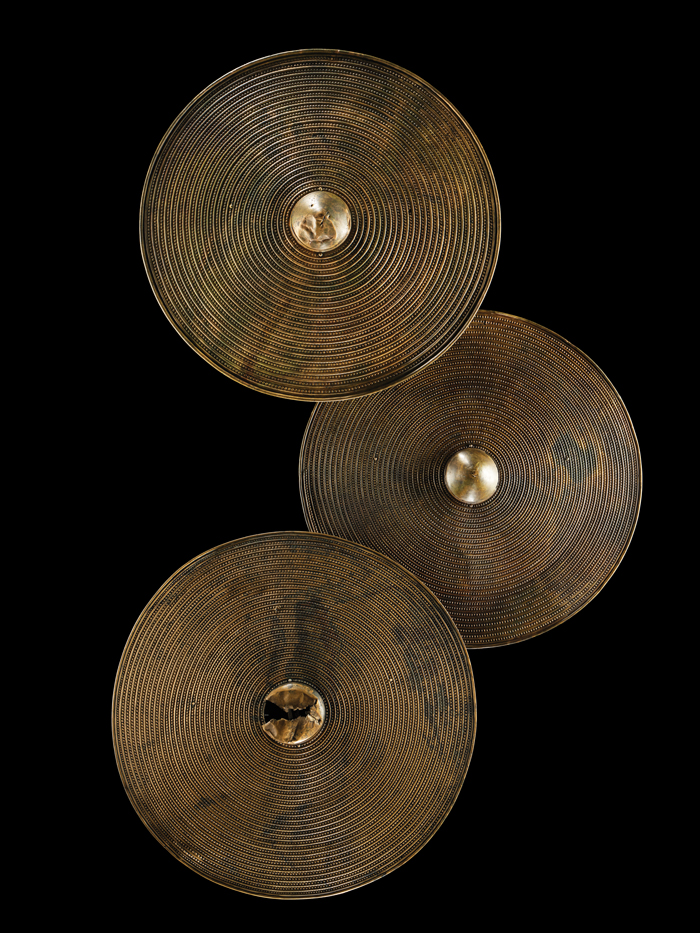
Undoubtedly, the most accomplished style is the Yetholm-type shield, so-named after three shields found near Yetholm in the Scottish Borders. These shields are thin, circular discs of bronze, hammered from a single ingot and ornamented with alternating concentric ribs and rows of thousands of individually crafted bosses. Dating to around 1300-1100 BC, they represent the pinnacle of Bronze Age craft.
Another example, from Beith, Ayrshire, is the only one now surviving from a group of five or six shields that were found, arranged in a ring, around 1779. This shield was presented to the Society of Antiquaries of London in 1791 and has been loaned to the exhibition, marking the first time that it has ever been displayed in Scotland. The suggestion that the shield had been placed in a ring of such objects is evocative and sparks the imagination, conjuring the idea that multiple people or communities might have come together to give up their shields. Was this a peacekeeping ceremony?
Like halberds, prehistoric shields have traditionally been considered as purely ceremonial items, but experiments over the last 20 years have demonstrated the effectiveness of a bronze shield for deflecting sword and spear blows. It appears that these seemingly thin and fragile objects were sometimes utilised in conflict.
This is an extract of an article that appeared in CA 437. Read on in the magazine, or click here to read it online at The Past, where you can read all of the Current Archaeology articles in full as well as the content of our other magazines, Current World Archaeology, Ancient Egypt, and Military History Matters.