Sometimes an artefact can create a powerful flash of recognition, linking your own experiences with those of someone who lived centuries earlier. I felt this kind of connection when visiting a new exhibition for this month’s ‘In Focus’. The displays, which tell the story of a woman who was buried in late Roman Colchester, include a hairpin whose shaft is covered with dents interpreted as possible teethmarks, evoking its owner holding the object in her mouth while fixing her hair. Almost 2,000 years later, I do the same thing every morning – though my hairgrips are cheap plastic rather than finely crafted Whitby jet!
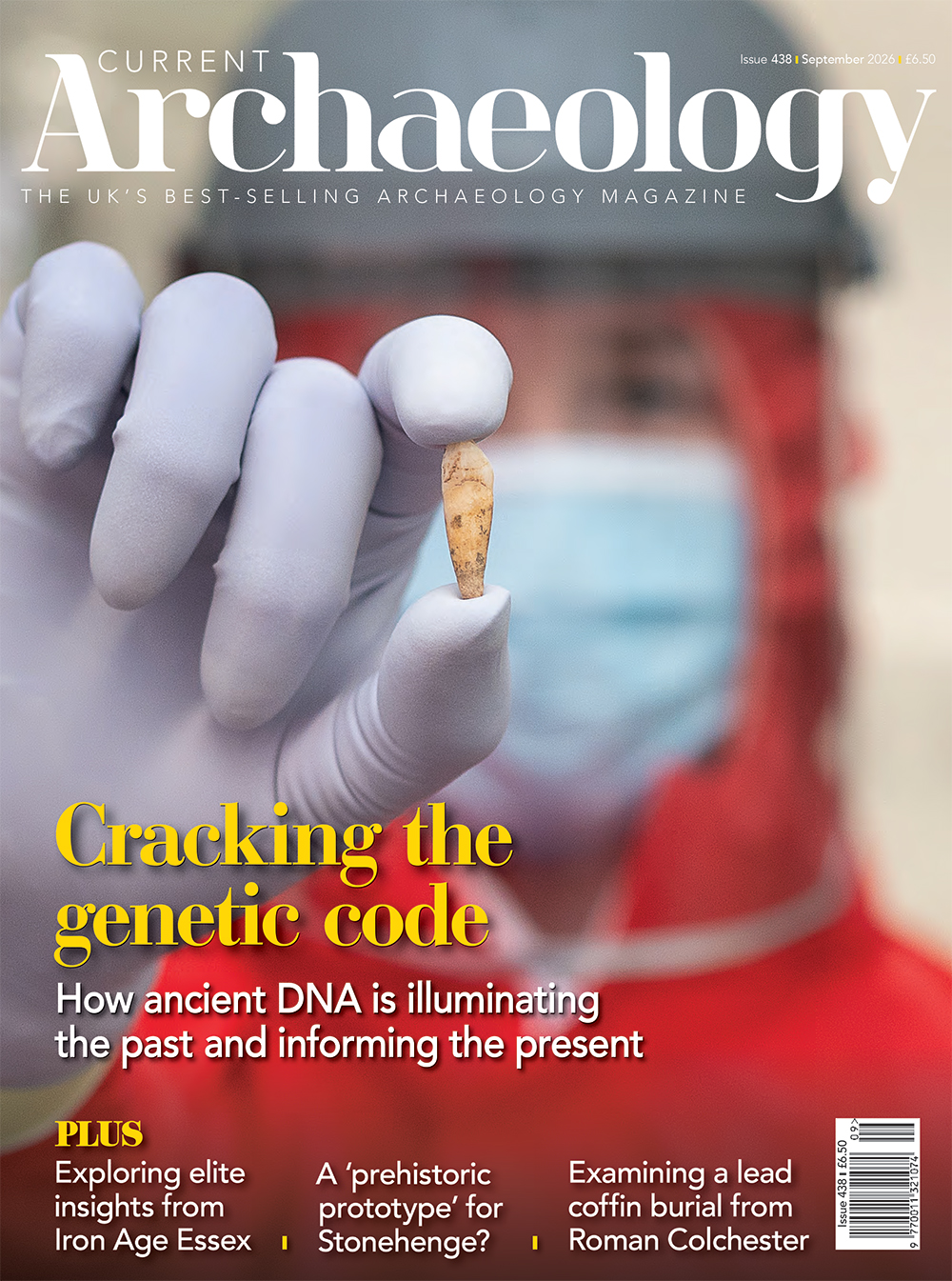
Thanks to the continuing advance of archaeological science, we can also glean amazingly precise and personal information about people from the past by analysing their DNA. Pioneering work by the Francis Crick Institute in London is bringing a wealth of illuminating stories to light once more, as our cover feature reports.
Our next article takes us to Iron Age Essex to examine two recent discoveries – the largest hoard of Iron Age gold coins yet found in Britain, and a series of elite burials – that shed intriguing light on how local people may have responded to early contact with the Roman world and the upheaval of invasion.
We then travel to Salisbury Plain to bring you a fuller account of an exciting discovery that we touched on briefly in last month’s CA: evidence that Late Neolithic communities may have gathered to hold solstice celebrations near Stonehenge 500 years before its famous sarsens were erected.
Complementing this discussion of ceremonial gatherings during the Neolithic period, we are also exploring another kind of place that has brought people together over the centuries: parish churches, specifically those of medieval Norwich.


In this issue:
FEATURES
CRACKING THE GENETIC CODE
Illuminating the past and informing the present with ancient DNA
Pioneering work by the Francis Crick Institute’s Ancient Genomics Laboratory is not only transforming our understanding of past people, populations, and pathogens; it is also helping with the development of modern medical treatments. The first exhibition of its kind, based at the Institute, explores some of these discoveries.
TRACES OF THE TRINOVANTES?
Exploring recent insights from Iron Age Essex
Two recent discoveries on the outskirts of Chelmsford – the Great Baddow Hoard, Britain’s largest assemblage of Iron Age gold coins, and a large cemetery with over 100 cremations, including unusual elite burials – are rewriting our understanding of Iron Age Essex.
I’LL FOLLOW THE SUN
Examining a prehistoric ‘prototype’ for Stonehenge’s solstice alignment
Recent research at Bulford has revealed the remains of a 5,000-year-old structure aligned with the solstices, suggesting that these astronomical events may have been celebrated on Salisbury Plain at least 500 years earlier than previously thought.
FULL OF FAITH
New insights into the medieval parish churches of Norwich
Norwich boasts more medieval churches than any other city north of the Alps. We explore the history of these ecclesiastical edifices and the ways in which the city is making use of them in light of dwindling congregations.
THE LEXDEN LADY
Examining a rare lead coffin burial from Roman Colchester
Roman Colchester is traditionally believed to have been on the decline by the late 4th century – but a recently discovered burial with an elaborate lead coffin tells a rather different story about life and death within the town during this period.
LETTERS
Your comments, complaints, and compliments
NEWS
Further finds from Halberton Roman villa; Signs of Bronze Age settlement at Haughey’s Fort; Prehistoric ‘circle’ identified on Machrie Moor; Prehistoric timber circle uncovered near Belfast; An Egyptian presence in Roman York?; Science Notes; Rare Genius at Vindolanda; Finds Tray
NEWS FOCUS
Made in England? New insights into the origins of the Sutton Hoo helmet
COMMENT
Joe Flatman excavates the CA archive, exploring sites associated with the early church
CONTEXT
Chalk it up to experience: Cerne Abbas, Dorchester
REVIEWS
Burials and the Black Death: the New Library excavation, Hereford Cathedral; Rhynie – a Powerful Place of Pictland: the development of a landscape of Pictish royal power from the Roman to the early medieval period; Roman Britain in Twenty Towns: a visitor’s guide; The Archaeology of Industrial Cheshire in 20 Digs; Shropshire: art, architecture, and archaeology from Roman Wroxeter to the sixteenth century; From Morocco to the Coast of England: the story of the Dom van Keulen and its remarkable cargo
EXPERIENCE
Kynren – the storied lands at Bishop Auckland, County Durham
ATTRACTION
Binchester Roman Fort, County Durham
EXHIBITION
Genghis Khan: How the Mongols Changed the World at the Royal Armouries Museum, Leeds
MUSEUM NEWS
The latest on acquisitions, exhibitions, and key decisions
LISTINGS
Our selection of exhibitions and events, as well as historical, archaeological, and cultural resources online
SHERDS
Chris Catling discusses the death of the Major Oak, the war on street trees, and Sheffield’s new policy for neglected heritage buildings
ODD SOCS
Cambridge Past, Present & Future