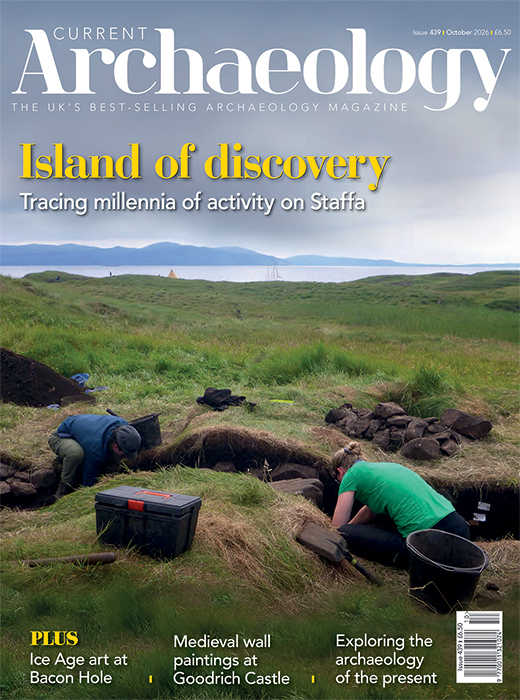
This year marks the 40th anniversary of the island of Staffa coming into the care of the National Trust for Scotland. Famed for its dramatic cliffs, caves, and black basalt columns, this picturesque portion of the Inner Hebrides has been asubject of scientific and artistic fascination – and a popular tourist destination – for centuries. Recent fieldwork has added to this picture, uncovering evidence of repeated visits, cultivation, and occupation stretching back to the post-medieval period, as well as unexpected echoes of even earlier activity dating to the Bronze Age, as our cover feature reports.
One of Staffa’s most intriguing aspects is the historic graffiti that has been recorded on the walls of Fingal’s Cave – and our second feature also highlights significant markings found within a cave, this time at Bacon Hole on the Gower Peninsula. There, a cluster of red lines were first reported as prehistoric paintings in 1912, but this interpretation proved controversial, sparking decades of debate and doubt. Can modern scientific investigations set the record straight?
Our next article examines British cemeteries, exploring how these peaceful places were influenced by historical, artistic, architectural, and literary interests, as well as by innovations in garden design. With many such sites now in a state of decline, how can we safeguard their legacy?
The articles above are mostly concerned with the distant past, or events on the cusp of living memory – but in our fourth feature we ask what can be learned by applying archaeological techniques to the present.
We end with an excursion to Goodrich Castle in Herefordshire, where recent conservation work has revealed traces of medieval wall-paintings showing that its chapel was much more elaborately decorated than previously thought.


In this issue:
FEATURES
STAFFA’S PAST SIGNATURES
Uncovering the hidden human history of a celebrated Scottish island
The Hebridean island of Staffa is famed for its natural beauty, but its archaeology has long been less well understood. Over the past decade, however, a series of excavations and surveys have revealed traces of people who lived, visited, and worked there over a period of thousands of years.
BACON HOLE
Rediscovering Britain’s forgotten Ice Age cave art
When a series of red lines was discovered in a cave on the Gower Peninsula in 1912, it sparked fierce debate about whether the lines represented ancient art or natural markings, before gradually fading back into obscurity. Can recent research using cutting-edge scientific techniques settle the argument once and for all?
GRAVE CONCERNS
Exploring the history of the British cemetery and its uncertain future
Cemeteries are not just places of burial: their designs represent decades of historical, horticultural, artistic, and even literary influences, as well as aesthetic and educational aspirations. We trace how these spaces have evolved over two centuries, and what can be done to protect their legacy in the face of modern decline.
UNEARTHING THE PRESENT
Why archaeologists should study the contemporary world
By definition, archaeology is the study of ancient things, but as well as transforming our understanding of the past, its techniques can shed vivid light on the present.
WORTH A THOUSAND WORDS
Examining medieval wall-paintings at Goodrich Castle
Recent conservation work at Goodrich Castle has revealed fragmentary traces of medieval wall-paintings, indicating that its chapel was far more elaborately decorated than was previously thought.
LETTERS
Your comments, complaints, and compliments
NEWS
New excavations shed light on Shropshire marsh-fort; Interpreting signs of child abuse in excavated remains; More finds from Magna Roman Fort; Roman hoard uncovered in Buckinghamshire; Fossil find from Roman Colchester; Science Notes; Oscar Wilde’s room rediscovered at Brighton hotel; Finds Tray
NEWS FOCUS
Brutality at Brading? Reinterpreting human remains from a Roman villa on the Isle of Wight
COMMENT
Joe Flatman excavates the CA archive, exploring monasteries of the high medieval period
CONTEXT
Historic drought reveals historic garden: Blenheim Palace, Oxfordshire
REVIEWS
Geevor: voices from a mining community; Feeding Medieval England: a long ‘Agricultural Revolution’, 700-1300; 50 Stone Age Finds from the Portable Antiquities Scheme; On the Banks of the Humber: archaeological and palaeoenvironmental investigations at Goxhill, North Lincolnshire, and Paull, East Yorkshire, 2016-2020; The Archaeology of Leicester in 20 Digs; Castlehill Wood (re-)Dun: reinterpreting a Stirling oddity
EXHIBITIONS
Following the Eagle at Segedunum Roman Fort, After the Fire at Arbeia Roman Fort, and Treasure: Hidden, Lost, Found at the Great North Museum: Hancock
MUSEUM NEWS
The latest on acquisitions, exhibitions, and key decisions
LISTINGS
Our selection of exhibitions and events, as well as historical, archaeological, and cultural resources online
SCOTTISH ARCHAEOLOGY MONTH
Highlights from the programme of heritage-themed events taking place during Scotland’s month-long celebration of archaeology
SHERDS
Chris Catling discusses heritage as health, Norman Hammond, and the future of pubs, cathedrals, and power stations
ODD SOCS
Friends of Abingdon Abbey Buildings Trust