After last month’s column on Westminster Cathedral, I will continue my ecclesiastical theme this month by exploring three of the great religious buildings in the north of England: York Minster, Durham Cathedral, and Whitby Abbey. All have played significant roles in both the religious and political history of our nation, and Current Archaeology has been there to tell their stories down the years.
YORK MINSTER
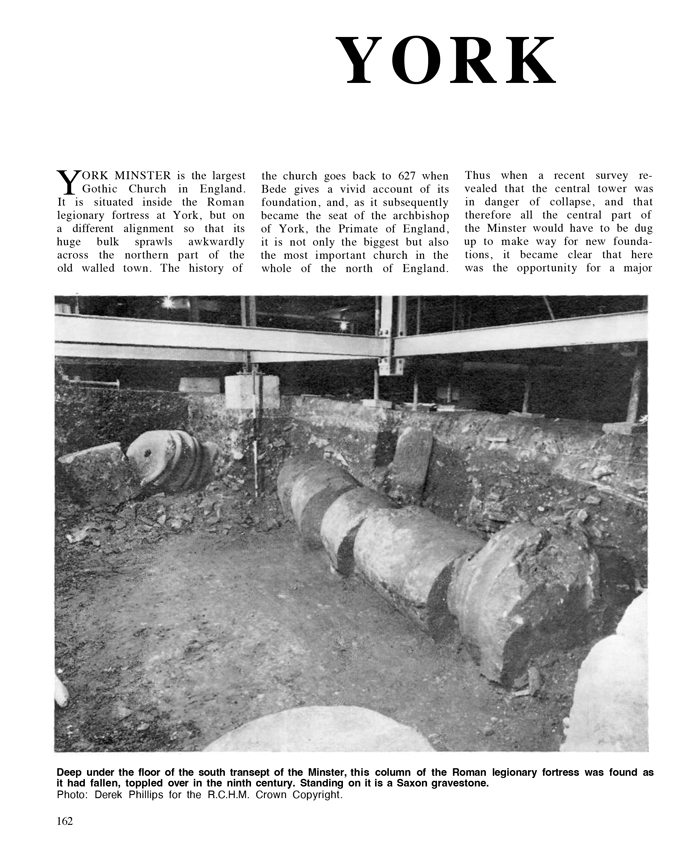
York Minster is, after Canterbury Cathedral, the most-important cathedral in England, since it is the seat of the Archbishop of York, the second-highest office of the Church of England. The oldest record of a church there dates to AD 627 and the earliest surviving fabric dates to c.1160, but the bulk of the building was constructed between 1220 and 1472. Current Archaeology has paid repeated visits to the Minster since the magazine’s earliest days, commencing in CA 17 (November 1969), at the time when its central tower required underpinning. This restoration necessitated an extensive programme of excavation that told us much about its early history and relationship to Roman, Viking, and Anglo-Saxon York, including the discovery of a late Anglo-Saxon cemetery beneath the later South Transept, intriguingly aligned north-west to south-east rather than the conventional east to west. This, together with other evidence, suggests that the original Anglo-Saxon minster was built to match the alignment of the underlying Roman fortress, while its successor took a new orientation in line with later Christian theology. The full report is well worth a read, and it should also be highlighted that one of the key individuals responsible for interpreting the mass of evidence accumulated in this 1960s fieldwork was Brenda Swinbank. One of the first women in Britain to become a ‘professional’ (that is, salaried) archaeologist, she is better known for her work on Hadrian’s Wall; CA 338 (May 2018) reviews her biography, while she is also counted among the ‘Mothers of Romano-British Studies’ celebrated in CA 427 (October 2025).
From the 1980s onwards, the magazine paid regular visits to the Minster to report on finds both large and small. For example, CA 103 (January 1987) described superb work on establishing the source and date of Roman glass reused in some of its 12th-century windows; CA 215 (February 2008) featured the find of a medieval clockmaker’s seal, representing an individual who had worked for the Minster c.1300; and CA 275 (February 2013) recounted the rediscovery of a Roman road (the Via Quintana) beneath the Minster’s undercroft, which would originally have been a back street of the Roman fortress headquarters. CA 277 (April 2013), meanwhile, covered discoveries made deep beneath the Minster. Work in advance of a new exhibition space shed light on the 400-year period between the departure of the Romans and the arrival of the Vikings in York, including coins in sealed contexts that provided detailed phasing, alongside evidence of post-Roman but pre-Viking settlement. After that, Current Archaeology’s coverage of the Minster became more scarce – although this issue of CA highlighted the results of a recent ground-penetrating radar surveys in the Minster precinct and other areas of York.
DURHAM CATHEDRAL
Alongside York, Durham Cathedral is one of the ‘great’ ecclesiastical buildings of the north of England. The seat of the bishop and the diocese of Durham, it contains the shrines of the Anglo-Saxon saints Cuthbert (c.634-687) and Bede (c.672/3-735), and is the formal successor to Lindisfarne Priory, which I will explore in a future column. After the island community was abandoned in 875, in the face of Viking raids, the monks of the priory settled at Chester-le-Street between 882 and 995, before moving on to Durham; the cathedral site continued as a monastery until its dissolution in 1541. In the intervening centuries, a substantial part of the present building was completed between 1093 and 1133; a chapel was added to the west end of the cathedral in the 1170s; the western towers were built c.1200; the east end was expanded in the 1230s; and the central tower was added in the 15th century. Current Archaeology first ventured there in issue 91 (March 1984), as part of a wider reassessment of the Anglo-Saxon church by Harold and Joan Taylor, but coverage then went quiet for over 30 years until CA 298 (January 2015) reported on the discovery of a 19th-century ‘time capsule’ hidden beneath a bookcase in the former monks’ dormitory and containing, among other items, newspapers dating to June/July 1880.
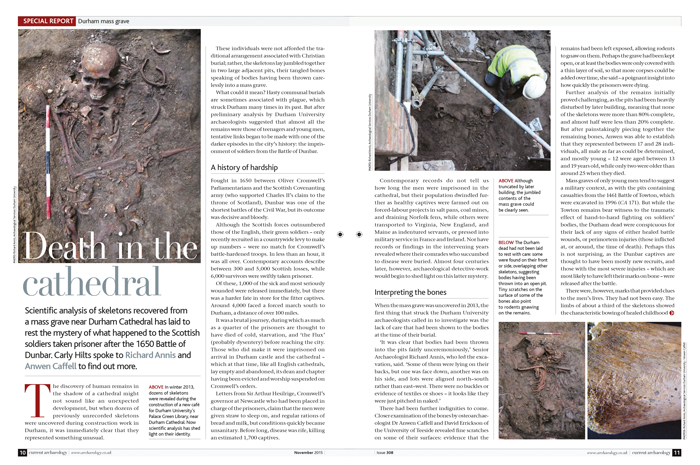
A more poignant find was then reported in CA 308 (November 2015): skeletons in a mass grave found near the cathedral, jumbled together in two large pits. Analyses established that these were the unhappy remains of Scottish soldiers captured in the September 1650 Battle of Dunbar: around 6,000 were captured at the battle, and some 4,000 were then marched south, with at least 1,000 said to have perished en route. The remaining men were housed around the Cathedral, in such poor conditions that disease became rife, as was explained in letters from Sir Arthur Hesilrige, then Governor of Newcastle, who had been placed in charge of the prisoners. Those who survived were farmed out as forced labour, transported to England’s North American colonies in modern-day Maine and Virginia, or pressed into military service. Painstaking analyses of the bones eventually showed that the excavated remains represented between 17 and 28 young men, all aged between 13 and 25 years old, though the majority were younger than 19. They all showed signs of ill health, including malnutrition and scurvy, that had affected them since childhood. This is the tale of the tragic end of some very tough young lives.
The latest coverage (in CA 392, November 2022) brings us full circle, returning to the theme of the magazine’s first mention of Durham Cathedral in in 1984: its place in the history of the Anglo-Saxon church. These two articles, written 40 years apart, are well worth reading together to see how thinking on the subject has evolved over time.
WHITBY ABBEY
Before I conclude this month’s column, I want to briefly visit another ‘great’ ecclesiastical site in the north of England: Whitby Abbey in North Yorkshire. While not a cathedral, this site played an important role in the early history of our nation. Whitby – most famous these days for its association with Bram Stoker’s 1897 novel Dracula and regularly drawing crowds of goths to the town on that basis – was a 7th-century double monastery that became a Benedictine community after the Norman Conquest. After its dissolution, it gradually became the atmospheric cliff-top ruin so beloved by tourists today. Its starring moment, though, came centuries earlier in AD 664, when the Synod of Whitby met there to resolve, among other issues, the question of whether the Northumbrian church would adopt the dating of Easter used in other Anglo-Saxon kingdoms to the south – essentially, the key moment in English history when monastic practice flipped in favour of the Continental model led from Rome and away from the earlier Celtic religious traditions.
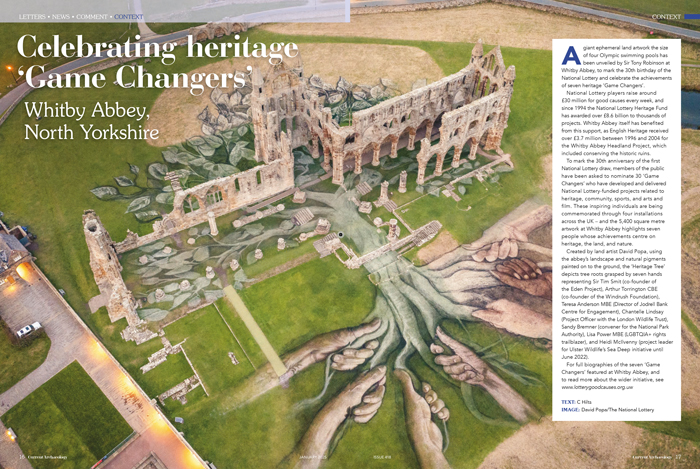
CA 163 (June 1999) first visited the abbey at the time that its custodians, English Heritage, were undertaking a full redevelopment of its facilities and interpretation. CA 291 (June 2014) returned with the exciting news of the discovery of a previously unknown chapel, thought likely to date to the time of the Synod, nestled amid a cemetery of the same era containing over 200 graves. Most recently, CA 418 (January 2025) returned to view a huge piece of landscape art temporarily installed across the site to celebrate 30 years of the National Lottery and thus of the lottery’s related Heritage Fund that has become such a crucial source of support for historic sites, structures, and projects across the country – contributing nearly £9 billion to-date.
All of the sites mentioned in this month’s column are regularly open to the public: see https://yorkminster.org, www.durhamcathedral.co.uk, and www.english-heritage.org.uk/visit/places/whitby-abbey.