In last month’s column, I examined a series of sites legacy of the Norman Conquest. One of these was Westminster Abbey, which I will now cover in more detail, alongside two other major church buildings that regularly feature in Current Archaeology: St Paul’s Cathedral and Canterbury Cathedral. These ecclesiastical settings comprise the starting point of a new mini-series in this column on the great Christian sites of Britain. Rich in archaeological and documentary evidence, all of them are living locations that have been used by generations of people down the ages to the modern day.
WESTMINSTER ABBEY
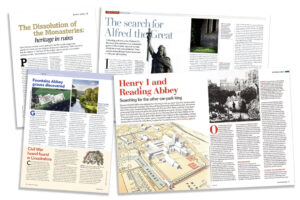
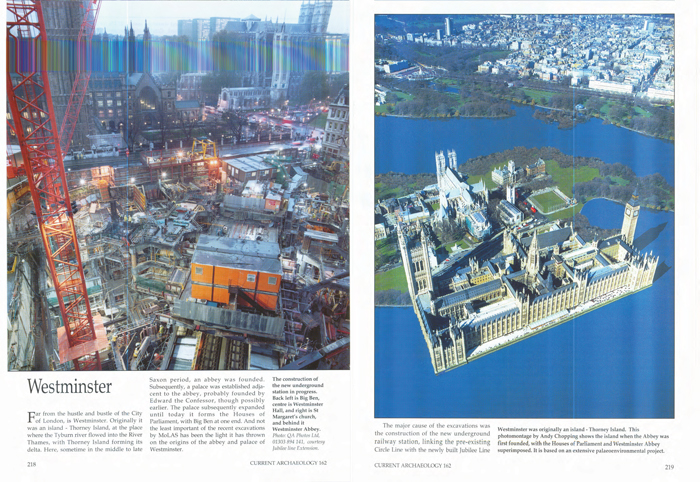
Westminster Abbey’s origins are unclear: religious occupation of the site dates back to at least the mid-10th century, when a Benedictine monastery was founded there, while the first iteration of what was to become the abbey was built during the 1040s, commissioned by King Edward the Confessor. Construction of the present church, meanwhile, began in 1245 on the orders of Henry III. Current Archaeology has examined aspects of all these elements of its history, commencing in CA 162 (April 1999), which provides a useful assessment of the wider geoarchaeology of Thorney Island on which both the Abbey and the nearby Parliamentary Estate sit. CA 201 (January 2006) next flagged finds from that location in an article published when the Museum of London’s medieval galleries were refurbished. With the (since renamed) London Museum’s new home in Smithfield nearing completion, I hope that such discoveries will soon be back on public display. The Abbey itself was then visited in CA 220 (July 2008) during conservation works to its rare pavement of late 13th-century ‘Cosmati’ mosaics – located in the sanctuary in front of the high altar, they are the only ones of their type to survive outside Italy; CA 359 (February 2020) then revisited the mosaics as part of commemorations of their 750th anniversary of completion in 1268, revealing their extraordinary craftsmanship. More conservation works were explored in CA 244 (July 2010) during the restoration of the Abbey’s chapter house: a part of the building that was begun in the 1250s under the orders of Henry III, but which was nearly lost during Henry VIII’s Dissolution of the Monasteries, and has since been regularly tweaked and changed over the centuries, including a major restoration in the 1860s.
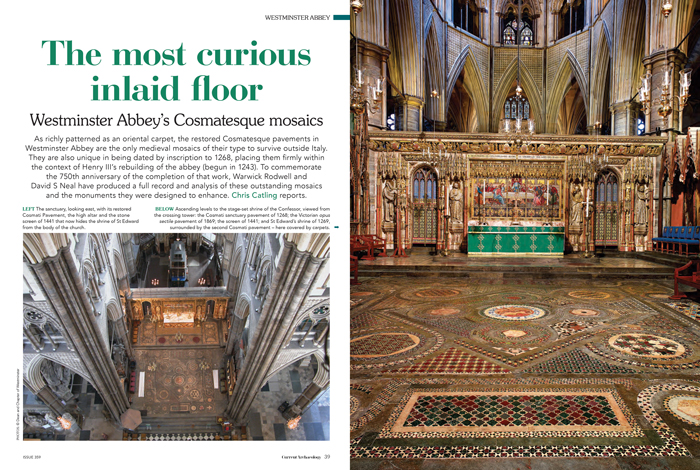
Aligned with the wedding of Prince William and Catherine Middleton in April 2011, CA returned to the Abbey in issue 254 (May 2011) to consider both its place in royal history (it has hosted no fewer than 14 royal weddings to date, more than any other religious location in the realm) and its origins, as evidenced by its early medieval remains, including burials hidden beneath the Northern Green that were examined by Time Team. A burial effigy of a much later and very different status, meanwhile, was examined in CA 268 (July 2012). It was associated with the mysterious Henry Stuart, James I’s eldest son who, had, he not died in 1612, would (we presume) have succeeded his father as Henry IX, rather than his brother, the ill-fated Charles I, doing so. (How different our history, including monarchical titles, might have been but for this ill fortune.) Another aspect of royal history featured in CA 283 (October 2013): the medieval (and later) Coronation Chair, in a piece of research – prompted by the Diamond Jubilee of Elizabeth II – that showed the complex story of just one small piece of the Abbey. For more on this and other finds, do visit the Abbey’s museum, which was refurbished in suitably grand style in the 2010s and reopened in 2018 in the eastern Triforium (the gallery above the nave), as discussed in CA 345 (December 2018).
ST PAUL’S CATHEDRAL
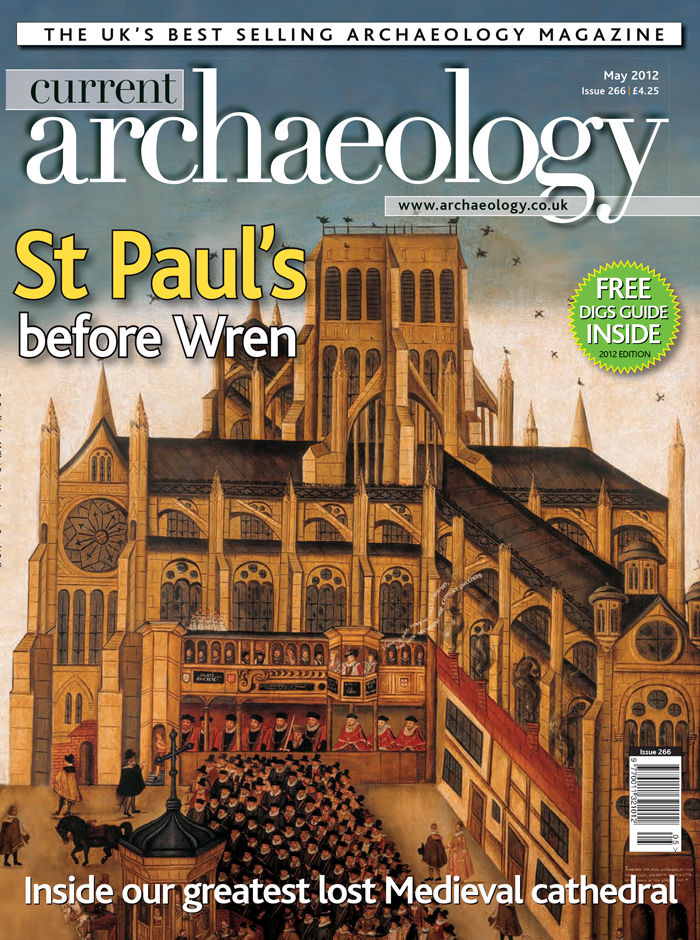
In comparison to Westminster Abbey, St Paul’s Cathedral has had more modest coverage in Current Archaeology, with its first proper mention coming quite recently in CA 254 (May 2011), the Royal Wedding special issue flagged above. On the other hand, unlike Westminster, St Paul’s has managed to gain the glory of a cover story, albeit in its earlier iteration, in CA 266 (May 2012). This article highlights the publication by John Schofield of a superb book on the site’s history, St Paul’s Cathedral before Wren (2011), which is the first to draw together evidence from medieval and antiquarian excavations, engravings, and documentary sources to reconstruct its full history. It has since been joined by a companion volume on the modern cathedral: St Paul’s Cathedral: archaeology and history (2016). This period of the cathedral’s history is also examined in CA 399 (June 2023) as part of the Wren 300 anniversary celebrations. The wider history and context of ‘old’ St Paul’s is covered in another book by John Schofield, London 1100-1600: the archaeology of a capital city (2011), which was discussed in CA 267 (June 2012) – for a companion piece to that research, see CA 338 (May 2018) on medieval London’s friaries, linked to the book The Friaries of Medieval London: from foundation to dissolution (2017) by Nick Holder.
‘Old’ St Paul’s was, as we all know from our school history lessons, lost in the Great Fire of September 1666, and this story, among many others, was examined in CA 318 (September 2016), although, as readers may be aware, for several years before the fire the cathedral was in contention for a major ‘facelift’ in a style matching Inigo Jones’ Classical additions of 1630. The wooden scaffolding that was in place to undertake these works in fact aided the old Cathedral’s rapid demise during the Fire, thus hastening its transformation into the now world-famous design by Wren, one of the most immediately recognisable buildings of Britain.
CANTERBURY CATHEDRAL
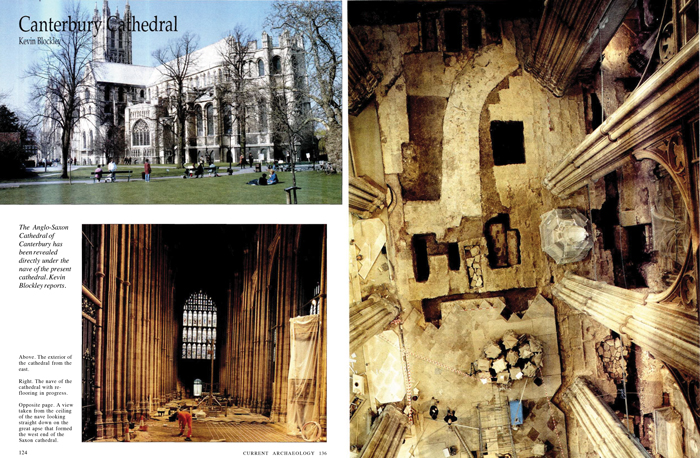
Alongside Westminster Abbey and St Paul’s Cathedral, Canterbury Cathedral is unquestionably one of the ‘great’ religious sites of Britain. Both in the present and the past, it is a place of pilgrimage and public acclaim, most recently evidenced by the enthronement of Sarah Mullally as its 106th Archbishop in a line stretching back to Augustine of Canterbury, the ‘Apostle to the English’, who was sent to this country by Pope Gregory the Great in AD 595. The archaeological history of the Cathedral is accordingly rich, and Current Archaeology has explored these riches repeatedly over the years. Coverage commenced in CA 91 (March 1984), on the origins of the Anglo-Saxon church in England, although it took until CA 136 (October 1993) for a detailed examination of the building itself, thanks to work undertaken at that time by the Canterbury Archaeological Trust. Since then, different elements of the building have been explored in detail, including its doors in CA 236 (November 2009), its columns in CA 289 (April 2014), and its floors in CA 397 (April 2023). Thankfully for Current Archaeology, a regular contributor to the magazine was also, at that time, the cathedral’s lead archaeological advisor: Nathalie Cohen of the National Trust, who took readers on a splendid tour of the building from crypt to roofline in CA 364 (July 2020). Another regular contributor to Current Archaeology, and another long-term researcher of the site (who worked at Westminster Abbey, too) is Warwick Rodwell, who explains the history of Trinity Chapel (the shrine of St Thomas Becket, martyred in 1170 allegedly on the orders of Henry II) in CA 398 (May 2023). The wider history of Becket was then explored by Chris Catling in CA 376 (July 2021) at the time of a British Museum exhibition about the saint. Together, these comprise a stunning series of analyses of one of the most fascinating of religious sites in the country.
I will continue this tour next month, heading north to, among others, Durham Cathedral and York Minster. All three sites mentioned in this column are open to the public, both for worship and general visits, see: www.westminster-abbey.org, www.stpauls.co.uk, and www.canterbury-cathedral.org.