Some 12 miles east of Norwich, Reedham’s church of St John the Baptist has a distinctive appearance, dominated by reused Roman stone, brick, and tile. Mike Fulford describes how archaeological research has identified a potential source for this material: a possibly military predecessor preserved beneath the existing medieval structure.

On the edge of the Great Estuary, into which flow the rivers Bure, Yare, and Waveney, St John
the Baptist, Reedham, stands on a small promontory of sand and shingle. Although the existing structure was mostly built c.1300 (though its west tower dates to the mid-15th century), it stands out from Norfolk’s many other medieval churches for the quantity of reused Roman building material in its fabric. Initially, archaeological attention focused on the Roman brick and tile, which is widely used in the nave and choir, and is especially prominent in the north wall, where a section from foundation to eaves is entirely built in this way. More recently, though, following a disastrous fire in 1981, Edwin Rose observed that the grey quartzite stone that is also abundant in the church has similarly ancient
origins. The same stone was used to build the Roman shore fort at Brancaster on the north Norfolk coast. Roman brick and stone therefore account for the great majority of building materials used in the medieval church – but what kind of structure had they been recycled from?

Tellingly, Professor John Allen traced the grey quartzite stone to the Leziate Beds of the Lower Cretaceous formation that overlooks the shores of the Wash in the Hunstanton–King’s Lynn–Downham Market area, in the north-west of the county. This is relatively close to Brancaster, but represents a journey of around 80 miles (130km) by sea to Reedham. Sourcing materials over such a distance suggests organised efforts, and it is likely that the Roman building for which they were destined had an official, possibly military, purpose. There has been considerable speculation over the years as to the nature of this structure and, given the position of the church in signalling distance of the Roman forts at Caister-on-Sea and Burgh Castle, a favoured interpretation has been that of a pharos (lighthouse) or signal station – or a building serving both functions – presumably located close to the site of the church. But where, exactly?

Over the years, several locations around the village have been suggested for where the Roman structure may have stood, but the obvious starting point is the church itself. In order to try to resolve this question – and, perhaps, establish the character of the Roman building itself – between 2013 and 2016 a small team from the University of Reading’s Department of Archaeology undertook geophysical surveys inside the church and within the churchyard, using ground penetrating radar. A subsequent, more targeted survey was carried out too in 2017, focusing on an area close to the walls of the church. The results of these investigations were intriguing: within the church, strong anomalies could be seen along the north and south sides of the nave, indicating wall remains running roughly parallel with each other but not quite lining up with the footprint of the present structure (deviating from the church’s orientation by about 10°). Meanwhile, across the churchyard there were further hints of possible building remains to the west.

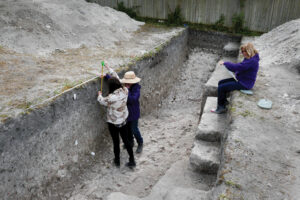
Unfortunately, it was not possible to follow up on the results of the survey within the church by excavation, but there were areas within the churchyard without headstones (and, potentially, without graves) where we could carry out very limited archaeological explorations, carefully targeted in order to avoid disturbing nearby burials. In total, we opened eight small trenches, each initially limited in size to 2m by 1m, though three were subsequently extended. Most were dug directly outside the church positioned as close as possible to the interior locations that had produced the strongest radar signals, while two other sondages were excavated a short distance to the west, to explore geophysical anomalies within the churchyard. Neither of these latter trenches revealed any underlying archaeology – but three of the church focused ones produced positive results.

ROMAN REMAINS
The clearest evidence of a Roman building preserved beneath the church came from Trench 7, which we opened on the south side of the nave, towards its eastern end. This trench had been positioned in order to explore why the interior radar survey had shown such strong results on the other side of the wall, and it did not disappoint, revealing a 2.2m-long section of Roman masonry. Measuring over 1m wide, this gently curving wall had a core of grey quartzite rubble and broken tile, faced with three tile courses above two courses of grey quartzite stone. The wall was set into a surface of hard, creamy mortar and, with its impressive dimensions and curved line, might represent the base of a tower or bastion.
On the north side of the nave, diagonally opposite Trench 7, a second, smaller fragment of Roman masonry, aligned north–south, emerged from Trench 4. Although only the lowest course of construction had survived (set on foundations of rough, unworked blocks), it was built in a similar way to the Trench 7 remains, comprising a rubble core faced with grey quartzite blocks, surrounded by creamy mortar. Finally, although Trench 3 – dug against the west face of the church tower – did not reveal any trace of actual masonry, it contained a mortar-rich fill suggestive of a robber trench that might testify to the presence of another Roman wall long-since plundered of its materials.

These discoveries were encouraging, but the biggest surprise came from Trench 5, which had been placed against the north wall of the nave, either side of a blocked-up arch which was loosely dated to c.1200. There, at a depth of about 0.45m, we found a floor surface made up of fragments of Roman brick and tile in a crumbly pale cream mortar, into which a few sherds of 10th-century Saxon pottery (identified
by Alice Lyons) had been trampled. Extending the trench a little further to the north produced a better-preserved surface of white plaster, as well as the remains of a wall aligned east west and made up of mortared pieces of Roman brick and tile.


Our immediate interpretation was that this, too, represented the remains of a Roman structure, but two samples taken from birch and oak charcoal found immediately beneath the mortared surface, and very close to the section of nave wall that is constructed solely of Roman brick and tile, gave radiocarbon dates of between the mid-7th and mid-to-late 8th century. Not what we were expecting! In fact, we had chanced upon evidence of the early history of the church, including an area – perhaps a side chapel or porticus – which had been accessible from the nave via the arch of c.1200. Measuring at least 11.5m by 3.75m, it survived long enough to be incorporated into the new, larger church that was built around 1200, but it was demolished around a century later, when the archway was blocked up and a new window inserted into the resulting wall.
This is an extract of an article that appeared in CA 420. Read on in the magazine, or click here to read it online at The Past, where you can read all of the Current Archaeology articles in full as well as the content of our other magazines, Current World Archaeology, Ancient Egypt, and Military History Matters.