In my second column on the archaeology of Greater London, I stroll through the Saxon town, meander through the medieval city, and finally alight on some post-medieval and modern sites. There is a lot to review here, from the evidence of London’s last Romans to those who lived here in some of its most difficult of times: the Blitz during the Second World War.
SAXON LUNDENWIC
An excellent starting point for this column is CA 213 (December 2007), which reported from St Martin-in-the Fields church in Trafalgar Square during a redevelopment at that time. Among other finds made was that of a sarcophagus containing the body of a middle-aged man buried c.AD 390- 430, at the end of the Roman era and start of the Saxon period.
It was linked to the origins of the church in the late Roman era and is therefore among the earliest surviving physical evidence of Christianity in Britain. This sets the scene nicely for wider examinations of the Saxon town of Lundenwic. When Current Archaeology launched in the late 1960s, the town’s precise location was yet to be identified, but we now know it to have been to the west of Roman Londinium, in the modern-day area of the Strand, Aldwych, and Covent Garden, as examined in CA 93 (August 1984), CA 124 (May 1991), and CA 158 (July 1998), among others. The origins of Westminster Abbey, further west, represent the other notable Saxon find from London, examined in CA 162 (April 1999). But it is an all-too brief snapshot of a still little-known period in the city’s history.
THE MEDIEVAL CITY
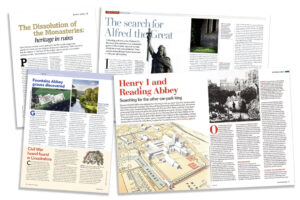
Moving into the medieval era, the sites and finds come thicker and faster, both within the ‘City’ (the boundaries of the old Roman settlement) and beyond, including back in Westminster. A great review of knowledge from early in the days of Current Archaeology comes in CA 49 (March 1975), and this can be contrasted with another ‘state of the nation’ survey in CA 201 (January 2006), when the medieval galleries of the Museum of London were redeveloped.

There is especially rich coverage from along the waterfront in this era: CA 66 (April 1979) and CA 244 (July 2010) give an excellent comparison of knowledge from here across a 30-year timespan, and more recently CA 346 (January 2019) explored the mountains of finds, of all types, made from the waterfront. A personal favourite is CA 391 (October 2022), which explored one of the City’s great lost treasures, its bridge, which was completed in 1209, partially dismantled and widened in 1761, and replaced in 1823-1831.
The church in various forms loomed large over the lives and livelihoods of medieval Londoners. An excellent review of their impact first came in CA 124 (May 1991), which examined the evidence from a host of churches across the City at this time. CA 162 (April 1999) followed up specifically on its monasteries, and more recently CA 338 (May 2018) explored its friaries, including their varied uses before and after the Reformation. Visits have also been made beyond the historic boundaries of the City – for example, to Merton’s Augustinian Priory in CA 225 (December 2008) and CA 269 (August 2012); to the Augustinian priory of St Mary Spital – in what became Spitalfields – in CA 363 (June 2020); and to Islington’s Carthusian Charterhouse in CA 336 (March 2018). The examination of the latter is also linked to wider studies of life and death in medieval London, including during the Plague: see CA 236 (November 2009), CA 278 (March 2013), and CA 291 (June 2014). But, above all, the two great religious foundations of modern-day London have rightly seen repeated examination – St Paul’s Cathedral in CA 266 (May 2012) and Westminster Abbey, including examinations of its early medieval structures in CA 254 (May 2011); its chapter house in CA 244 (July 2010); its effigies in CA 268 (July 2012); its museum in CA 345 (December 2018); and, most recently, its mosaics in CA 359 (February 2020).

POST-MEDIEVAL LONDON
CA’s forays into early modern London focus above all on the archaeology of Shakespeare, featuring sites that are as stunning as they are influential: the campaign to save the Rose Playhouse on Bankside (Southwark), for example, was a milestone in the political history of British archaeology that has shaped approaches to the identification, protection, and management of sites across the nation to this day. CA 115 (June 1989) explored this site first, and CA 124 (May 1991) followed up in detail, both on its archaeology and on its archaeologists, especially Harvey Sheldon, who led the fieldwork there at the
time. CA 225 (December 2008) then reported from the site known as ‘The Theatre’ in Shoreditch, and CA 269 (August 2012) from the Curtain Theatre, also in Shoreditch. More recently, CA 287 (February 2014) returned to Bankside and the area around the Hope Theatre to explore its wider social history in this period, a ‘pleasure ground’ of beer houses and brothels, theatres, and animal ‘sports’ – a London not for the faint-hearted. For those interested in this rougher side of city life, I flag to you three further features: the archaeology of the Great Fire of 1666 in CA 318 (September 2016); of the city’s public executions in CA 393 (December 2022); and of its equine inhabitants in CA 411 (June 2024). A neat contrast to this low living then comes in a series of reports down the years from London’s royal palaces, including from Hampton Court in CA 140 (September 1994), CA 181 (September 2002), and CA 204 (July 2006); the Tower of London in CA 154 (September 1997); Richmond Palace in CA 193 (August 2004); Kew Palace in CA 196 (March 2005); and St James’s Palace in CA 394 (January 2023).

THE MODERN AGE
Finally, what of 19th- and 20th-century London? Current Archaeology has told two particularly important stories here. First, covering the city’s development into an industrial powerhouse as evidenced by, among other examples, its railway heritage: see CA 216 (March 2008) and CA 256 (July 2011) on King’s Cross/St Pancras stations. The grandeur of the railway stations is painfully juxtaposed to the poverty experienced by those living in the slums of Bermondsey and Tower Hamlets in CA 258 (September 2011) and CA 264 (March 2012), and, even worse, in the workhouses where the destitute ended up: see CA 406 (January 2024). Second, CA has increasingly explored the 20th-century archaeology of the city, especially the impact of the Second World War, following the emergence of such thematic studies as a sub discipline in the same time-frame. CA 201 (January 2006) and CA 368 (November 2020), for example, explored the evidence of the Blitz in Shoreditch, and CA 228 (March 2009) investigated the remnants of the Home Guard in aptly named Shooters Hill on the borders of Greenwich and Bexley.

With this final column on London, I conclude a tour of the archaeology of the British Isles through the pages of Current Archaeology that I began back in CA 360 and which I have sustained across 57 consecutive columns. I return next month with a new focus – I will be looking at ‘great sites’ excavated down the years. I promise that there will be many readers’ favourites, ranging in date from prehistory to the modern day, but please drop me a line if you would like to see any featured in particular.
About the author

Joe Flatman completed a PhD in medieval archaeology at the University of Southampton in 2003, and since then has held positions in universities, and local and – most recently – central government. Since March 2019, he has been a Consultancy Manager in the National Trust’s London and South-East Region, leading a team working on Trust sites across Hampshire and the Isle of Wight. You can follow him on X: @joeflatman.