Examining the Norton Disney dodecahedron in its wider context

Around 130 dodecahedra have been found across the northern Roman Empire, but the purpose of these ornate objects is unknown, and few have been recovered from datable contexts in modern excavations. An important exception forms the focus of an exhibition exploring the archaeology of Potter Hill, Lincolnshire. Carly Hilts visited the displays and spoke to Chris Clay, Richard Parker, and Clare Pickersgill to learn more.
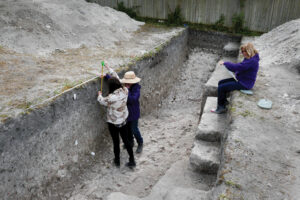
It is a running joke in archaeology that the most significant finds tend to emerge right at the end of an excavation – and this was certainly the case during an ongoing community project near Norton Disney in Lincolnshire. In the summer of 2023, Norton Disney History and Archaeology Group were working with Allen Archaeology to investigate a possible Roman settlement at Potter Hill, close to the known location of a villa (which was dug in the 1930s) and the line of the Fosse Way (the Roman road between Exeter and Lincoln). As that season of digging drew towards its close, they had opened a final trenchover a large Roman sand-quarrying pit, which had later been reused as a handy place to dump refuse. Its fill contained a wealth of familiar finds, from pieces of pottery to ceramic building materials – but towards the top was something more unusual: a copper-alloy dodecahedron.

Around 130 examples of these enigmatic objects are known from across the Roman Empire, with previous discoveries scattered across modern Austria, Belgium, Britain, France, Germany, Hungary, Luxembourg, the Netherlands, and Switzerland. Despite this wide geographic spread, it is striking that they all come from the north-western provinces of the Empire (and predominantly from Gaul), with none known from the imperial heartlands of Italy or the wider Mediterranean area, and none from Roman territories in Africa. The Norton Disney example is the 33rd to emerge from Britain, but it is the first from the Midlands.
Each dodecahedron has common features – they are hollow, 12-sided objects cast from copper-alloy, with a hole in each face and a round knob at each vertex – but no two are exactly alike, and they vary greatly in size, ranging from the dimensions of a golf ball to a tennis ball. What is clear, however, is that they would have been very complex to create, requiring great skill and a lot of metal to cast. The effort and expense involved in making a single dodecahedron suggests that they may have held some kind of special significance – but no written reference to them is known from any surviving Roman text, and no depiction has been identified in mosaics or wall paintings. For now, their purpose remains obscure, though diverse theories have been put forward.

One option posits that they are a kind of surveying tool, though the fact that the dodecahedra are not of a standard size and lack numbering or other marks that could help with the taking of measurements casts doubt on this. Other interpretations include a candleholder, a knitting dolly, or even a child’s toy, though such mundane uses seem odd when clay or wooden equivalents could have been created much more cheaply to achieve the same result. By contrast, some suggest that dodecahedra had no practical function at all, but were instead a ‘test piece’ intended to demonstrate the skill of a particular artisan. Alternatively, perhaps we should fall back on the archaeological catch-all of ‘ritual’. It has been proposed that dodecahedra could have played some kind of role in divination rites, or might, with their 12 faces, be linked to the signs of the Zodiac, though there is no obvious way to distinguish one side from another or apply any specific symbolism to each.
The discovery of the Norton Disney dodecahedron has not solved this mystery, but it represents a particularly well-preserved example, with many others existing in a damaged or very fragmentary state. At 8cm tall, it is one of the largest dodecahedra yet found in Britain, and is surprisingly heavy at 245g. Archaeometallurgical analysis revealed the reason: its alloy includes a strikingly high proportion of lead, at 27 per cent (together with 63 per cent copper and traces of other metals), which was possibly intended to help the metal flow more easily into its mould to create the object’s intricate design. This dodecahedron is also unusual because it was found during a modern excavation (many others are antiquarian finds: the first-known British example was discovered in 1739) and within a datable archaeological context. This wider story is explored in an exhibition currently running at the University of Nottingham Museum, which places the dodecahedron within the much longer story of human activity at Potter Hill, which has seen millennia of occupation.

This is an extract of an article that appeared in CA 429. Read on in the magazine, or click here to read it online at The Past, where you can read all of the Current Archaeology articles in full as well as the content of our other magazines, Current World Archaeology, Ancient Egypt, and Military History Matters.