Encountering a community from 19th-century Blackburn

On 30 September 1820, the cornerstone for a new Anglican church was laid in Blackburn town centre. Consecrated the following year, St Peter’s had been built to help accommodate the Lancashire town’s rapidly growing population – a demographic boom largely driven by the flourishing local textile industry. As well as supporting the spiritual needs of its living congregation, the church had a cemetery that was in regular use, receiving over 6,000 burials until 1858 when a new municipal cemetery was built on the outskirts of the increasingly crowded urban area. The church itself continued as a busy place of worship for almost another century, but in 1974 a partial roof collapse prompted its permanent closure and, two years later, demolition. The site was transformed into an open green space, and there St Peter’s and its burial ground maintained a ghostly presence, with the outline of its foundations periodically reappearing as parch marks during particularly dry weather, while a number of recumbent memorial stones remained visible as a reminder of the park’s former life.
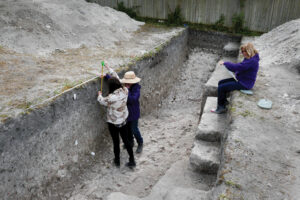
Around this peaceful spot, Blackburn’s urban environment continued to evolve and, in the 2010s, the site was set to be redeveloped as part of the construction of a new link road. The entire footprint of St Peter’s Church and around a third of its burial ground lay within the new route’s path and, following trial-trenching by Oxford Archaeology North, in 2015 Headland Archaeology carried out a full-scale excavation of the affected area. During these investigations (commissioned by Capita on behalf of Blackburn with Darwen Borough Council), Headland Archaeology uncovered and recorded the church’s surviving masonry ahead of its removal; documented 176 memorial stones; and recovered the remains of 1,959 men, women, and children in one of the largest excavations of a 19th-century cemetery undertaken outside London.

The project was operating in a tight time-frame, with construction schedules and contractual obligations requiring all exhumed individuals to be reburied less than a year after the excavations ended (they were reinterred in 2016, in a reserved area of the church grounds to the north-east of the new road, with a memorial service led by the Bishop of Blackburn). Despite this narrow window, detailed scientific analysis and historical research has revealed an impressive sweep of information about the individuals who had been buried at St Peter’s almost 200 years earlier – including putting names to 64 of them, thanks to surviving coffin plates and burial registers. Recently published in a comprehensive new monograph, the results of these investigations offer illuminating, surprising, and sometimes poignant insights into the experiences and aspirations of the community to which the people of St Peter’s belonged.
SOCIAL PATTERNS
This is not a story of rich and poor, but of middling and less well-off people. Contemporary burial records attest that the people interred at St Peter’s included tailors and teachers, shopkeepers and shoemakers, publicans and clergymen; they were neither the very humblest in society, nor Blackburn’s great and good (who had their family vaults at the more prestigious churches of St Mary and St John). Even so, social stratification – and late Georgian/early Victorian social attitudes – could still be seen in the way that the cemetery was laid out. Three portions of the burial ground (comprising about a third of the total area) fell within the scope of the road scheme and were excavated by Headland Archaeology: two large zones to the north and south of the church, and a smaller piece to the north-east. It was immediately apparent that the first two areas were much more densely packed with graves, containing an average of 1.37 and 1.39 burials per m3 respectively compared to the north-eastern part’s relatively spacious 0.79 per m3. This difference, the monograph’s authors suggest, may be because the eastern and western areas of the cemetery held greater social status – lying as they did along the main paths to the church doors, where memorials could be seen and admired by passers-by – and were therefore limited to people who could afford these more desirable plots.

Something that also became apparent as the project progressed was that children represented a huge proportion of the cemetery population. Infant mortality (defined as a baby born alive but dying before their first birthday) was a persistent scourge in the 19th century, affecting an average of 150 in every 1,000 children in England and Wales, and records attest that Blackburn was struggling with a rate well above the average at 187 per 1,000. At St Peter’s, one might therefore expect infants to make up around 19% of the cemetery population, but in fact they comprised 23.7% of all the excavated individuals whose age could be determined, and 28.1% of those recorded in contemporary burial registers. Nor were those who reached their 12-month milestone out of danger: children aged 1-5 made up another 34.7% of the examined skeletons, and in total 70.3% of the remains recovered from the site represented those under 18 years old. Most of these came from less prestigious parts of the burial ground, and comparison with contemporary records suggests that this was not selection bias owing to these areas being more widely excavated: it appears that children were much more likely to be interred in these zones than to the east and west.
By contrast, written and excavated evidence tell very different stories about the balance of males and females within the cemetery. Within the recovered remains the ratio was dramatically skewed, with women outnumbering men at a ratio of 307:199. Burial records attest, however, that roughly equal numbers of each sex were laid to rest at St Peter’s. The difference is where they were buried, with a larger proportion of women apparently being interred within the less prestigious areas, and the missing men presumably still resting within the more-valued but less-excavated eastern and western portions.

This is an extract of an article that appeared in CA 428. Read on in the magazine, or click here to read it online at The Past, where you can read all of the Current Archaeology articles in full as well as the content of our other magazines, Current World Archaeology, Ancient Egypt, and Military History Matters.