Exploring the archaeology of Ben Lomond

Ben Lomond is one of Scotland’s most famous mountains, lying on the edge of the Highland boundary fault, with its shouldered profile dominating the skyline of the Central Belt and the Trossachs. Over the last three decades, National Trust for Scotland staff have been unpicking the archaeological and historical stories preserved within this landscape, bringing them to the attention of the public once more. Derek Alexander and Alasdair Eckersall report.
Ben Lomond forms the central focus of Scotland’s first National Park, Loch Lomond and the Trossachs, which was established in 2002. As the most southerly Munro (a Scottish mountain over 3,000ft in height – Ben Lomond measures 3,196ft), it is often people’s first introduction to hillwalking in Scotland, climbed by more than 50,000 people every year, with another 40,000 passing its western foot as they walk along the shore-side, long-distance trail called the West Highland Way. The National Trust for Scotland looks after 2,173ha (5,370 acres) of the mountain, which has numerous natural heritage designations but no Scheduled Monuments. Over recent decades, however, archaeological fieldwork has documented an equally rich historic environment within the NTS estate.
Our story begins back in 1995, when the Trust commissioned John Hunter and a team from the University of Bradford, and later of Birmingham, to undertake an archaeological walkover survey of Ben Lomond. This investigation proved remarkably productive, locating some 44 house sites concentrated around the lochside settlements of Blairvockie and Ardess, as well as five shieling groups higher up the hillside at Coille Mhor, Coire Odhar, Coire Corrach, Glashet Burn, and Tom Eas. There were also lengths of dyke and areas of ridge-and-furrow cultivation, while the team also recorded a number of bloomery mounds – small furnaces associated with iron production.
The results of this survey still form the core of the Trust’s Historic Environment Record for the property, and more recent excavations have added important details to this data set. Let’s explore some of the key findings, from the lochside up to the mountain’s summit.

KAILYARD CLUES
The first site to be excavated in 1995 was a 19th-century farmstead at Ross, on the improved, low-lying ground beside the loch on what today is Blairvockie Farm. The fields in this area were known to have been a focus of settlement, with around 30 households spread across seven different townships by the early 1700s, though some had disappeared by the start of the 19th century. On this particular site, during the original investigation, the team produced an excellent plan of the surviving buildings, as well as carrying out a geophysical survey of the surrounding area and opening a number of small trial trenches.

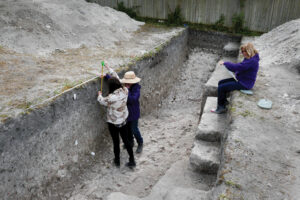
There was still more to learn, though, and a couple of years ago the Trust revisited the site to open more trenches, as well as a grid of test pits in the kailyard (a kind of small, enclosed garden plot) to the north. Excavating in kailyards is a technique we have used at a number of locations (Ben Lawers, Torridon, Iona, and Glencoe); these gardens were used for winter vegetables, and the assumption is that waste material and rubbish would have been dumped on a midden heap before being spread over the enclosed plot – making them fertile ground for finds. Sure enough, at Ross the ten test pits excavated in the kailyard recovered a range of pottery, glass, and clay tobacco-pipe fragments. We opened two trenches, too, within the rectangular building lying to the south of the main farmstead block. Trench 1 revealed a well-built cobbled floor from which a clay tobacco-pipe bowl was recovered, while Trench 2 proved even more illuminating. Located within the western part of the structure, it revealed a floor surface on which lay horse shoes, part of a horse harness, and a gin trap. Perhaps this small space had served as a tack room.
HIDDEN HISTORY
The remains of the 19th-century farm at Ross are fairly typical of the area, but they lie in a rather unvisited spot on the Trust’s estate. Most visitors to Ben Lomond either follow the main footpath to the summit or take the loch-side route along the West Highland Way. Ben Lomond property manager Alasdair Eckersall recognised the need for a new low-level path that would allow more casual visitors to explore the lower slopes of the Ben and perhaps some of the archaeological remains that can be found in this area. The result was the Ardess Hidden History Trail, a footpath that was set up in 2001 and wound its way up from the Trust’s Ranger centre along 12 designated stops. Back then, none of the sites had been excavated – but that picture has completely changed over the past 25 years.

During that period, all of the major elements on the trail have been examined archaeologically, among them a number of different domestic structures including a probable wash house built between two burns. The interior of the structure itself only yielded a single sherd of trailed slipware pottery and some bottle glass, but in the adjacent burn we found clearer clues about its function: an iron hoop from a tub or barrel, along with a solid iron for ironing clothes.
Meanwhile, at the northern end of the walk, there was a cluster of four buildings which may have formed part of a small township. Three of these had low stone foundations with rounded corners and are thought to date to the 18th century. Might they be linked to one of the area’s more infamous inhabitants? In 1711, Rob Roy MacGregor is known to have been the tenant of a farm at Ardess before he passed it on to a nephew when he was declared an outlaw. There was also a single better-built drystone structure with right-angled corners, which is marked as Tigh an Eas (‘The House at the Water’) on the first edition Ordnance Survey map of 1866. Excavation revealed a nicely paved internal floor surface very similar to that discovered at Ross. There is an extensive drystone sheepfold just up slope to the north, and it is likely that the excavated structure reflects the use of this part of the mountain as part of a sheep farm.

These 18th- and 19th-century buildings were associated with a cultivated area whose upper limit was marked (at approximately the 100m contour line) by a curved fieldbank, or head dyke. This feature was clearly faced with large boulders on the uphill side to prevent cattle and perhaps sheep from straying down into the ripening crops during summer months. Patches of ridge-and-furrow cultivation traces survive, and one area of woodland points to trees having been planted in the 19th century – probably by the landowner, the Duke of Montrose, either to replace ones that had been felled, or as a commercial venture. Wood harvested along Loch Lomond’s banks was used both for charcoal-making and for its bark, which was used in the production of turpentine.

A fragment of a 19th-century pipe bearing an image of Stephenson’s Rocket. IMAGE: National Trust for Scotland
On the current edge of the woodland, a small, turf-walled structure was initially thought to be an early turf house, possibly medieval in date (similarly sized turf buildings at Ben Lawers – another Trust property, on north Lochtayside – had been dated to the 11th-13th century), but excavation in 2006 only recovered 19th-century material. This did, however, include a rather nice piece of clay tobacco pipe decorated with an image of Stephenson’s Rocket locomotive of 1826. Rather than medieval, this seems to have been a 19th-century hut that was used as a small house, perhaps for a couple who worked in the woods.
This is an extract of an article that appeared in CA 432. Read on in the magazine, or click here to read it online at The Past, where you can read all of the Current Archaeology articles in full as well as the content of our other magazines, Current World Archaeology, Ancient Egypt, and Military History Matters.