Earliest evidence of humans making fire discovered in Suffolk

Excavations at East Farm, Barnham, have uncovered the oldest-known traces of deliberate fire-making – a game-changing step in the human story that we now know took place 350,000 years earlier than was previously thought. Carly Hilts reports.
In ancient Greek mythology, the Titan Prometeus transformed the fortunes of humanity when he stole fire from the gods, literally sparking civilisation. While this story is the stuff of legend, though, it is true that fire has fuelled major advances throughout history, from the development of metalworking to the Industrial Revolution.
When did early humans first learn to harness flames to their own advantage? Archaeological evidence from open-air sites in Kenya and cave deposits in South Africa speak of fire-use dating back as far as 1.6 million to 1.4 million years ago. These traces, however, are thought to represent people making the most of naturally occurring blazes, gathering embers in the aftermath of a lightning strike or a wildfire, and carrying them home so that they could be carefully rekindled. Keeping this fire going would have been a time-consuming and resource-intensive task – one that would have needed the dedicated attention of at least one member of the group, who would then not be available for essential everyday tasks like hunting or gathering food and other resources. Moreover, however well- tended a fire was, a sudden downpour could quickly extinguish these efforts, leaving the group waiting and hoping for another unpredictable opportunity to start the whole process again.

Developing the ability to make fire whenever it was needed was a step-change in human evolution. Offering a reliable source of warmth and light, it helped Palaeolithic populations to adapt to a much wider range of environments, particularly as early humans established themselves in colder climates like northern Europe and Britain (places where handy lightning strikes are also typically accompanied by heavy rain). Until recently, the earliest-known certain evidence for fire-making, rather than simply fire-use, was relatively late, dating back just 50,000 years. A number of late Neanderthal sites in France have produced hand-axes preserving evidence of use-wear which (experimental archaeology using replica artefacts suggests) indicate that they had been struck with pyrite. When struck against flint, this mineral produces showers of sparks that can be used to ignite tinder, making it a very efficient fire-lighter. Now, however, a team of researchers led by the British Museum have unearthed much earlier evidence of this activity at Barnham in Suffolk. Their findings, recently published in Nature, have pushed back the story of human fire-making by 350,000 years.

LOCATION, LOCATION
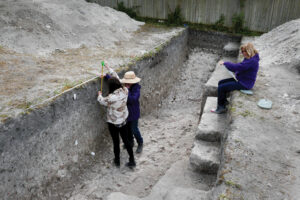
East Farm, Barnham, lies about 2 miles (3km) south of Thetford. In the late 19th century, the site was home to a clay pit that served the local brick-making industry until it was abandoned in the early 20th century, but these works are also known to have uncovered the remains of prehistoric animals, as well as flint tools pointing to human presence. More recently, East Farm witnessed a rather different form of digging, with British Museum excavations unearthing further clues between 1989 and 1994, and since 2013 the site has hosted a student field school, run under the auspices of the Pathways to Ancient Britain (PAB) project. A successor to the Ancient Human Occupation of Britain project (see CA 190 and 288), this is a collaboration between the British Museum, the Natural History Museum, Queen Mary University of London, UCL, the University of Liverpool, and Leiden University, funded by the Calleva Foundation. It aims to shed light on three periods of early human presence in Britain, from the first occupation of these shores through to the extinction of Neanderthals and the emergence of modern humans.
Over the last decade, PAB’s investigations at Barnham have uncovered environmental evidence and animal remains that paint a vivid picture of a stream-fed pond surrounded by grassland and deciduous trees. This landscape was inhabited by large animals, including elephants and bison, as well as early humans. Excavation of the long-dried-up pond’s sediments has recovered flint tools speaking of two phases of human activity: the first, represented by cores, waste flakes, and simple flaked tools, is thought to reflect intrepid groups venturing back into Britain as the ice sheets retreated c.420,000 years ago. Then, some years later but during the same warm interglacial period, another group visited the site, leaving behind rather more complex flint hand-axes. It is this second, more recent, phase that has produced the all-important evidence of fire-making.

This is an extract of an article that appeared in CA 431. Read on in the magazine, or click here to read it online at The Past, where you can read all of the Current Archaeology articles in full as well as the content of our other magazines, Current World Archaeology, Ancient Egypt, and Military History Matters.