Exploring landscapes of power in early medieval East Anglia

Over the last two decades, evidence of a high-status early medieval settlement has been emerging just four miles from Sutton Hoo. What can Rendlesham tell us about the evolution and exercise of royal power in early medieval England? Carly Hilts spoke to Christopher Scull, Faye Minter, Stuart Brookes, and Tom Williamson to learn more.
Today, Rendlesham is a rural village near Woodbridge in south-east Suffolk, but for a long time it was an intriguing footnote in the story of early medieval East Anglia. The site appears briefly in Bede’s Ecclesiastical History, where it is described as a vicus regius or ‘royal settlement’. Like the Northumbrian power centre at Yeavering, some 250 miles (400km) to the north, Bede depicts Rendlesham as a place of royally sanctioned baptism during the 7th century, and interest in its early medieval importance grew exponentially following the discovery of Sutton Hoo’s princely burials just four miles away in 1939. However, unlike Yeavering (whose palatial complex was first excavated by Brian Hope-Taylor in the 1950s, with subsequent investigations most recently including fieldwork led by Durham University and The Gefrin Trust; see CA 384 and 405), Rendlesham’s reputed royal residence proved stubbornly elusive, with several different locations within the parish suggested. Fieldwalking in the 1980s had produced quantities of 5th- to 9th-century pottery in fields to the north and west of the parish church of St Gregory, indicating occupation of this period, but there was little or nothing to suggest a settlement of the status described by Bede.

High-quality metalwork from Rendlesham, including gold-and-garnet jewellery, indicates an elite settlement: the site of the vicus regius described by Bede. Scale: 3:1
IMAGES: © Suffolk County Council
Over the last two decades, though, this picture has dramatically changed, thanks to a series of linked archaeological initiatives that have gradually teased clues from the Suffolk soil, bringing a long-vanished community back into brilliant focus. During the course of this work, individual discoveries were published in archaeological journals, but now the team’s wider interpretations have been brought together in a comprehensive monograph, complemented by a paper in Medieval Archaeologythat summarises three years of excavation on the site (both are open access online, see links above). Their findings add illuminating new details to our knowledge not only of elite early medieval activity within the immediate area of the Deben river valley, but of wider landscapes of power that appear to have been more organised, more interconnected, and more enduring than was previously thought. Here, we will explore some of the key themes from this research, tracing the rise and decline of this majorpower centre, placing it within its wider context, and examining what it means for our understanding of the early East Anglian kingdom.
SEARCHING FOR A SETTLEMENT
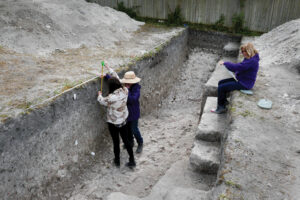
The story of Rendlesham’s rediscovery begins in earnest in 2007, when the owner of nearby Naunton Hall raised the alarm about illegal metal-detecting on his land. Suffolk County Council Archaeological Service sprang into action, organising a controlled survey by four trusted detectorists who had all worked with the council or on commercial excavations in the past. Their investigation produced coins and other metal finds testifying to 5th- to 8th-century activity with a distinctively high-status emphasis – so, in light of these finds (and faced with further illegal metal-detecting raids on Naunton Hall’s fields), the pilot study was extended and expanded. Between 2008 and 2014, the same team of detectorists systematically examined the entire estate – an area of c.170ha (420 acres) – and, combined with geophysical surveys and a detailed examination of aerial photographs of the area, this work provided vital clues to the settlement’s nature, location, and extent.

PHOTO: Graham Allen © Suffolk County Council
Of the 5,000 or so items that were recovered from the plough soil during these investigations, 27% belonged to the early medieval period. To put that figure in context, the project team note that early medieval finds make up just 5% of all discoveries recorded by the Portable Antiquities Scheme for the whole of Suffolk. The strikingly skewed proportion at Rendlesham therefore points to a significant focus of activity in this area – but where was the settlement itself? The precise find spot of every metal-detected object had been carefully logged using GPS in order to build up a picture of the distribution and density of this intriguing artefact-scatter, and geophysical surveys undertaken over the greatest concentration of finds revealed a complex array of underlying archaeological features. Trial-trenching followed in 2013, revealing that some of these were Grubenhäuser, the characteristic sunken featured structures associated with early medieval settlements.
Until this point, the team emphasise, this was never a grand project, but a succession of short initiatives operating around the agricultural calendar and working from one portion of funding to the next. A step-change in the scale of their work came in 2017, though, when a grant from the Leverhulme Trust funded expert analysis of the enormous dataset represented by the metal-detected finds, which sparked a 3.5-year multidisciplinary project based at University College London Institute of Archaeology, the University of East Anglia, and the Fitzwilliam Museum in Cambridge. Complementing this work, another major grant (this time from the National Lottery Heritage Fund) supported the creation of ‘Rendlesham Revealed’, a community archaeology project run by Suffolk County Council Archaeological Service. Drawing together diverse local groups, this initiative carried out three summer excavations between 2021 and 2023,targeting key features identified during the previous geophysical surveys. The twin threads of this research weave together a detailed picture of both elite and everyday activities in 5th- to 8th-century East Anglia, seen through the lens of the largest and materially richest settlement of its date yet identified in England.

IMAGE: contains OS data © Crown copyright and database right 2024
This is an extract of an article that appeared in CA 430. Read on in the magazine, or click here to read it online at The Past, where you can read all of the Current Archaeology articles in full as well as the content of our other magazines, Current World Archaeology, Ancient Egypt, and Military History Matters.