Uncovering the hidden human history of a celebrated Scottish island
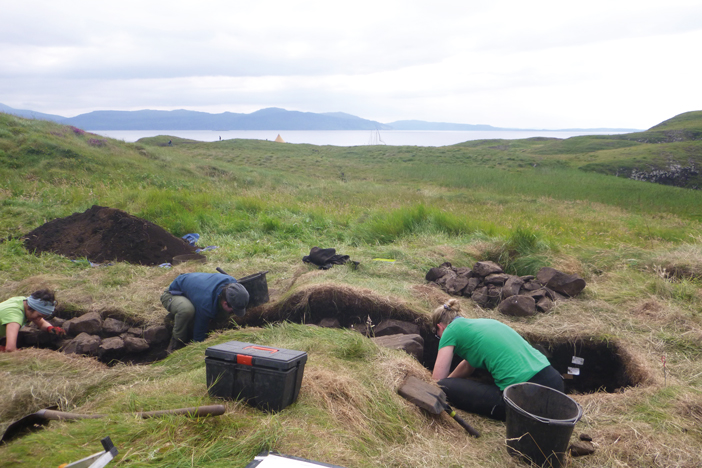
A small team of archaeologists has been undertaking research into the island of Staffa in the Inner Hebrides. Camping for a few days at a time over a number of years, they have carried out both survey and excavation work. Derek Alexander, Daniel Rhodes, Stuart Jeffrey, Tessa Poller, and Siân Jones describe the results of these efforts to date.
For generations, Staffa has of natural wonders. Rising dramatically from the Atlantic, west of Mull, its black basalt columns and the soaring cathedral of Fingal’s Cave have inspired travellers, artists, musicians, and scientists since the intrepid naturalist Joseph Banks first brought the island to wider public attention in 1772. Wordsworth marvelled at it, Mendelssohn transformed its atmosphere into music, Turner painted it, and Queen Victoria made the journey to see it for herself.
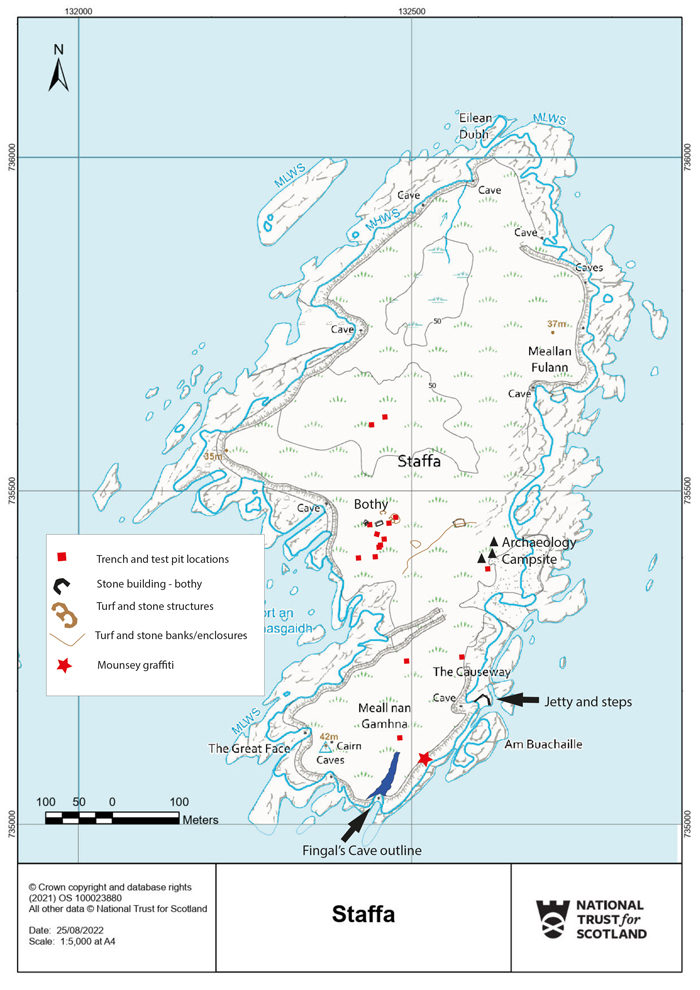
Yet, for all its fame, Staffa’s human story has remained surprisingly little known. Visitors (today, around 80,000-90,000 a year) tend to view it as an island shaped by geology rather than people, a place of puffins, sea caves, and volcanic rock. Recent archaeological investigations have revealed a rather different picture, however. Beneath the turf, around the ruins in the island’s centre, and even beneath the structures built for Victorian tourists, survives evidence of a landscape that has been occupied, farmed, visited, and experienced for thousands of years.
The opportunity to tell this story is particularly timely. The completion of recent work to improve Staffa’s landing facilities and visitor access has prompted renewed examination of the archaeological evidence for earlier jetties and stairways, while 2026 marks 40 years since the National Trust for Scotland took the island into its care. Over the last decade, collaborative research undertaken by the National Trust for Scotland, the Universities of Glasgow and Stirling, and the Glasgow School of Art has transformed our understanding of one of Scotland’s best-known islands. What has emerged is a story stretching from Second World War naval activity and Victorian tourists to the Bronze Age communities who called the island home nearly 4,000 years ago.
REACHING THE ISLAND
The first challenge for anyone visiting Staffa has always been landing on it. Today, visitors arrive via a modern jetty and a substantial stairway, climbing from Clamshell Cave on to the island plateau. These facilities represent only the latest chapter in a long history of attempts to tame an exposed Atlantic shoreline that offers no natural harbour, often involving surrounding island communities.
When the first wave of tourists began arriving after Banks’ visit in 1772, there were no formal landing facilities. Visitors were often put ashore directly on to the rocks from small boats, and contemporary accounts describe travellers scrambling along slippery foreshore ledges or climbing steep slopes to reach the island interior. Early illustrations even show boats landing passengers at the entrance to Fingal’s Cave itself.
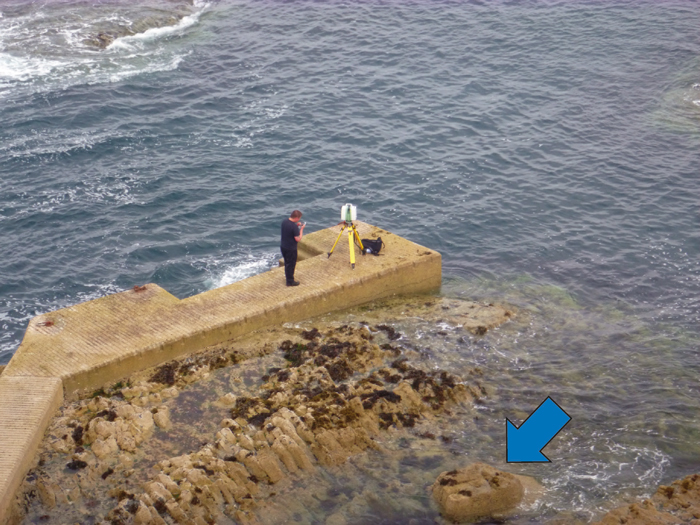
As visitor numbers increased throughout the 19th century, though, improvements followed. By the 1830s, a timber stairway had been built beside Clamshell Cave, allowing access up the cliff and along the coast, via a natural feature, the ‘Causeway’, to Fingal’s Cave. Historic photographs suggest that this was replaced around 1885 by a much larger double-width wooden staircase, complete with handrails and life rings. Visitors could ascend on one side and descend on the other, reflecting Staffa’s growing popularity as an organised tourist destination.
The 20th century brought further modifications, some of which feature in the social memory and oral histories of surrounding island communities closely connected to Staffa. The wooden stairs were removed in the 1930s and replaced with narrower concrete works, while sections of the famous Causeway were altered to improve access. New stairs followed in 1977, and a concrete-and-steel jetty was completed in 1991 following the National Trust for Scotland’s acquisition of the island.
Archaeological survey undertaken in advance of the most recent jetty improvements, which only opened earlier this year, identified surviving traces of several of these earlier schemes. Concrete foundations, rusting steelwork, walkway supports, and landing-stage remains survive around Clamshell Cave, preserving a remarkable sequence of visitor infrastructure spanning almost two centuries. Although individually modest, these remains represent the physical archaeology and valued everyday heritage of tourism itself.
RECORDING A GLOBAL ICON
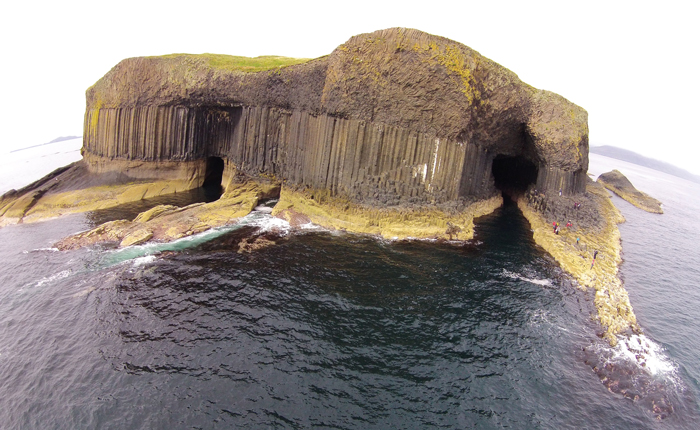
The emblematic heart of Staffa remains Fingal’s Cave, one of the most recognisable natural features in Europe. In 2014, the cave became the focus of an ambitious programme of digital recording. Laser-scanning captured the entire southern end of the island, together with the cave interior, producing an exceptionally detailed three-dimensional model of the basalt columns and the great sea cavern itself. Acoustic specialists simultaneously undertook a series of sound sweeps, allowing the cave’s remarkable acoustic properties to be modelled and visualised for the first time.
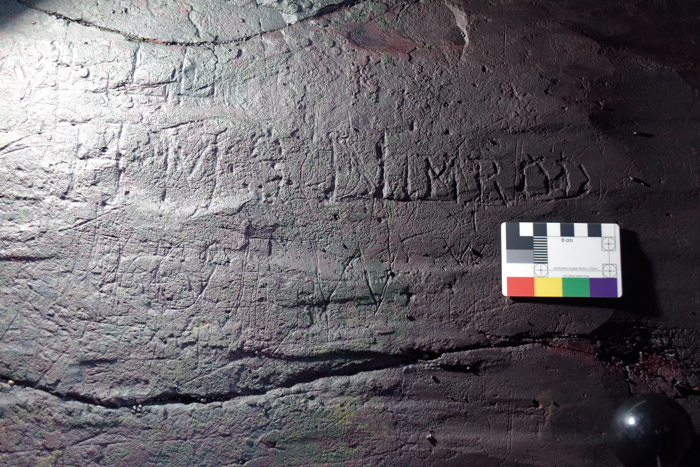
The work revealed far more than dramatic geology. Among the features recorded were numerous historical graffiti inscriptions carved into the cave walls and along the approach. These names, initials, dates, and commemorative marks were left by generations of visitors who wished to preserve a memory of reaching one of Europe’s most celebrated destinations. Today, such carvings might be considered vandalism, but these examples represent significant historical records, as they include mentions of multiple naval vessels spanning the 19th century to the Second World War, and naming vessels from the Royal Navy, the Royal Netherlands Navy, the German Navy, and more. Some of their names – HMS Quentin Roosevelt, HMS Alecto, HMS Nimrod – conjure fascinating stories in their own right, speaking of various famous naval missions, though – perhaps strangely – so far there is no trace of the mine-sweeping trawler HMS Staffa. The graffiti includes some identifiable individuals and groups, and a little outside Fingal’s Cave itself we find a previously unknown example of the work of the notorious Victorian adventurer William Mounsey. Famous for the cryptic ‘Persian’ graffiti that he left on the Neolithic Dwarfie Stane, a rock-cut tomb on Hoy in Orkney, on Staffa Mounsey favoured a Latin motto (dvlcissima solitvdo [sic], probably to mean ‘sweetest solitude’) and a Star of David. Although not Jewish, his interest in mysticism and symbolism led him to be known as the ‘Jew of Carlisle’. On the Dwarfie Stane and Staffa alike, he signed his inscription with the same enigmatic, Latinised, and reversed version of his name, ‘Yesnvom Svmleilug’. Both places were apparently inscribed in the same year, 1850.
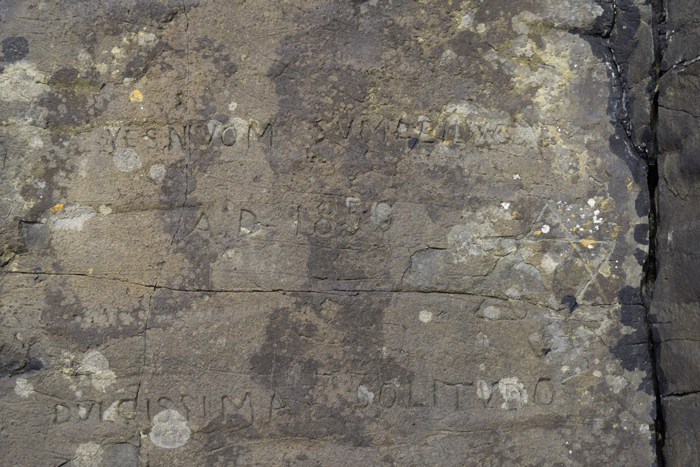
These graffiti provide evidence for individual journeys, but also networks of relationships both military and civilian, illuminating the strength of connection felt by visitors during the great age of Romantic tourism and later. While each inscription points to a personal encounter with Staffa’s extraordinary landscape, taken together they signal the urge of many to write themselves permanently into the story of the island and the wonders it represents.
This is an extract of an article that appeared in CA 439. Read on in the magazine, or click here to read it online at The Past, where you can read all of the Current Archaeology articles in full as well as the content of our other magazines, Current World Archaeology, Ancient Egypt, and Military History Matters.